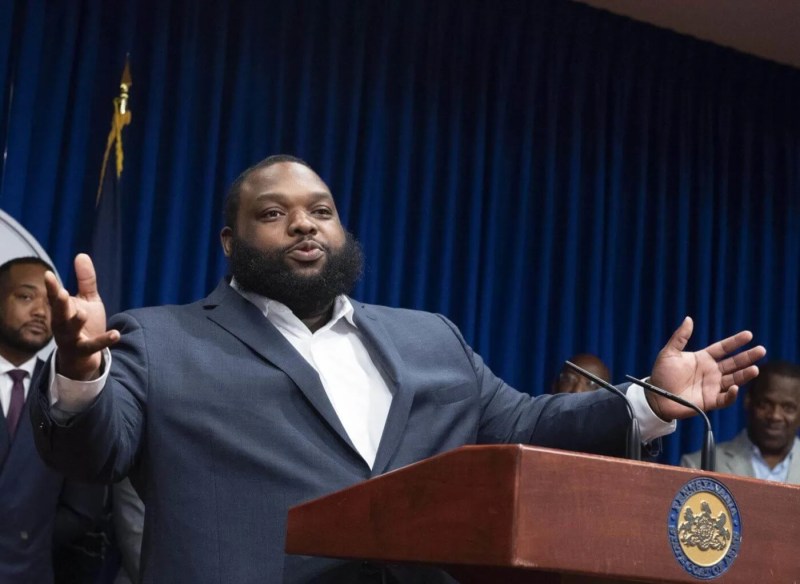
Appropriations chair’s goal is to have an on-time budget this year
Weeks after Gov. Josh Shapiro pitched a $53.2 billion spending plan for the commonwealth’s next fiscal year, House Democrats shared their own vision — which is identical to Shapiro’s.
Appropriations Chair Rep. Jordan Harris (D-Philadelphia) formally filed the bill with legislative services on Tuesday, emphasizing his caucus’ alignment with Pennsylvania’s chief executive.
“If you look at the governor’s budget address, it addresses a lot of the concerns that House Democrats have been working on for years,” Harris told reporters. “(This bill) is our continued work with the governor on addressing those issues, and this budget reflects that.”
Shapiro, and House Democrats, propose funding part of the 5.4% increase over last year’s spending plan through taxes on legalized recreational cannabis and electronic skill games — which have been included in previous budgets and rejected annually by Senate Republicans.
Though Democrats hold the governor’s seat and House — the latter with just a one-seat majority — Republicans hold a slim majority in the Senate, meaning all parties must come to a consensus. Negotiations stretched past the June 30 deadline last year — as they have for six of the last ten years — and the budget was finalized 135 days late, leaving counties, schools and nonprofits in a financial lurch.
Harris vowed to avoid that outcome this year. Every member of the House and half of the Senate is up for reelection in November. Shapiro is also running for a second term.
“It is our goal to have an on-time budget this year, understanding that when we delay that there are many school districts and nonprofits and others who sometimes incur additional costs as well as (those) who are just left in limbo until we get our budget done,” Harris said.
“There is no need for us to wait until the last minute to negotiate this budget and to get things done,” he added.
Budget criticism
But Republicans have repeatedly criticized the proposal for spending too much, pointing to a $6.7 billion structural deficit, or the gap between the state’s predicted revenues and expenses. That number doesn’t include new taxes included in Shapiro’s proposal.
Rep. Jesse Topper (R-Bedford) shared his opposition to the minimum wage increase from the floor later Tuesday afternoon during a vote.
“I’m not sure what all of the proposals will be as we enter this budget season, maybe there’s a path to a compromise, not just on this piece of legislation, but on those those pieces of legislation that will enable us to ensure everyone is reaching that maximum wage that they can reach in their field,” said Topper.
Harris panned that number, questioning the calculations used by the state’s Independent Fiscal Office and pointing to slightly elevated tax collections.
“We have our numbers, and this is what we’re moving forward with,” said Harris.
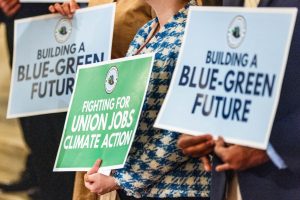
Nearly 80% of the budget’s expenditures are dedicated to just two state agencies: the Department of Human Services with $21.9 billion and the Department of Education with $20.6 billion. Roughly $1 billion of the increase to DHS will fund Medicaid increases, which Democrats said will shrink if the state increases the minimum wage from $7.25 per hour — the federal minimum — to $15.
“These are things that we believe need to happen,” said Harris ahead of an expected House vote on the minimum wage increase later that day.
“The bottom line is: if folks do not want to generate the revenue, fine. We need to know their list of cuts. We need to know what nursing homes they want to cut. We need to know what home care agencies are no longer going to get funding. We need to know what schools are going to get cut, and what teachers and nurses we’re going to send home,” he continued.
Home health agencies have decried the budget plan for not including rate increases — despite the commonwealth’s growing elderly population with intensive medical needs. Harris said he believed workers deserved increases, which fall short of the $15/hour minimum wage proposal.
When asked if his caucus had a contingency plan for if the revenue generating proposals fail, Harris said no, later adding that he hadn’t yet talked with Republican colleagues.
“What we’ve done is introduced a balanced budget that we believe addresses many of the issues that the people of Pennsylvania care about,” said Harris. “We look forward to our friends in the Republican-controlled state Senate meeting us at the table, putting forth their own plan (and) letting the people of Pennsylvania know what they want to pay.”