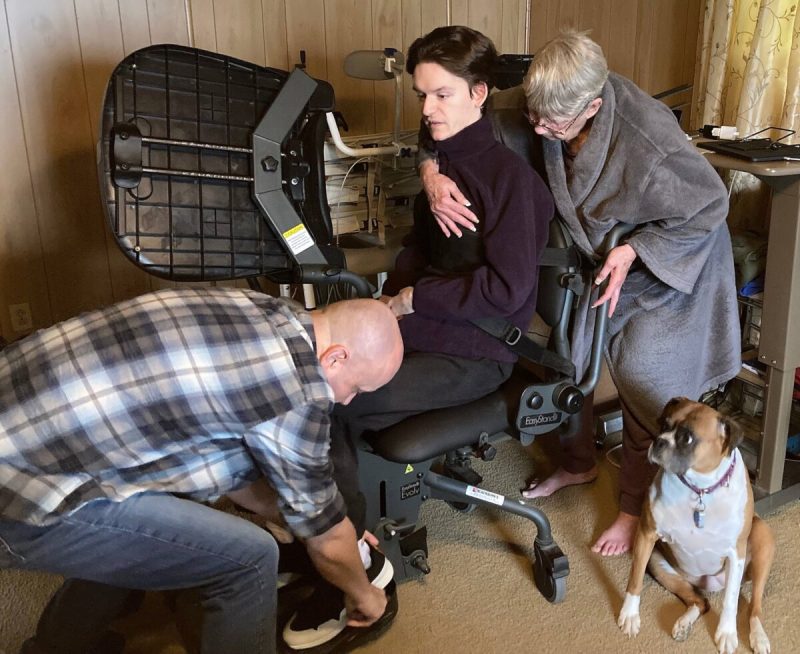
Living in a wheelchair hasn’t stopped Tyler King from accomplishing some of his life goals.
The 23-year-old Waterford Township man is set to graduate from PennWest Edinboro in May with a bachelor’s degree in business administration, a concentration in quantitative finance, and minors in global business and economics.
“I have been speaking with a career counselor, and I decided that I either want to work in wealth management or be a motivational speaker,” King said. “I’m also interested in being a spokesperson. I like promoting a positive message.”
King is also a realist. Since he can’t move his legs and has limited use of his arms, he requires assistance to perform daily tasks of living, including getting in and out of bed, bathing, dressing and using the bathroom.
His primary caregivers have been his grandparents, with whom King lives, and nurses from Bayada Home Health Care.
“But my grandparents are getting older and they soon will need caregivers of their own,” King said.
That would mean King would rely more on the Bayada nurses and that could be a problem.
Medicaid pays for King’s home health care and its reimbursement rates in Pennsylvania for home health aides and nurses have been almost stagnant for the past 12 years.
A home health aide for a client with physical disabilities in Erie County earns an average of just over $13 an hour, while a home health nurse earns $25 to $30 an hour — less than what those nurses can earn elsewhere.
Overall, Pennsylvania reimburses personal care workers an average of $20.63 an hour, far less than Maryland ($25.58), Ohio ($28.96) and New York state ($36.31), according to a Pennsylvania Homecare Association survey.
As a result, Pennsylvania’s home health agencies are struggling to hire aides and nurses.
Pennsylvania home health providers average 110,000 hours a week that they are approved to staff but can’t find personnel, said Lanisha Chimenti, a Bayada client services manager who advocates for home health providers statewide.
“If the shortage worsens, fewer clients like Tyler would be able to remain at home, where they are the most comfortable and the care provided is the least expensive,” said Chimenti, whose daughter requires home health care.
It’s one reason why King has spoken at local events to raise awareness about the low home health care reimbursements for people with physical disabilities. He has called on local state legislators to fight to raise the pay for these workers.
Bayada nurses care for King overnights and during the day. His grandparents have traditionally taken the late-afternoon/early evening shift but it’s time to hire another nurse.
If Bayada can find one.
“My poppa works two jobs to support us, so he’s sometimes out during those hours,” King said. “My grandma is my caregiver during those hours but it’s getting harder for her. It’s a physical job. I need readjusted on a regular basis and help going to the bathroom.”
King injured in bicycle accident in 2015
King was injured in a bicycle accident near his home in 2015. Years of therapy allow him to perform some basic tasks with his arms and eventually return to school.
He has been taking remote classes at PennWest Edinboro, using a laptop and a computer tablet that he controls with either his breath or a mouth stylus.
“It’s not just for classes,” King said when a voice called out to him from his tablet. “I have a girlfriend in Vietnam and we are always on Face Time together.”
Support system key to King’s success
King is proud of what he has accomplished since his injury but also realizes what can happen without his support system.
Like others with spinal injuries, King said that he is susceptible to autonomic dysreflexia, a potentially life-threatening overreaction of his autonomic nervous system. It can be triggered by not being repositioned, or catheterized to go to the bathroom.
“What happens in my blood pressure spikes and it could quickly reach the point where I could suffer a brain aneurysm and die,” King said.
If there aren’t enough available home health nurses to provide continuous care for King, he might have to move into a group home or long-term care facility.
“It’s a constant worry of mine,” King said. “I would lose out on my quality of life. This is my home, where I am comfortable.”