On Oct. 27, 2025, more than 100 people packed into the pews at Bible Baptist Church for a meeting of the Conewago Township Planning Commission.
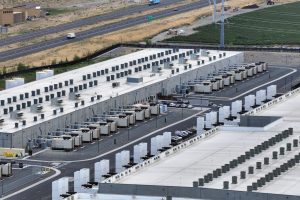
Among those in the church was Jim Rexroth. The rest of the crowd, it seemed, was there to talk about him. Specifically, they were there to oppose the notion that his 541 acres of farmland on Bowers Bridge Road could one day be the site of a massive data center, believing that the noise and environmental damage caused by the facility would change the character of the rural area and that its massive power consumption would cause their electricity rates to skyrocket.
Rexroth, who farms some 5,400 acres in York County, was there to explain that the property was not prime farmland, that it was challenging to even break even on the corn, wheat and soybeans grown there, that in the future “nobody is going to farm that land just to break even,” and that it was inevitable that it would be developed.
In fact, when he bought the land 17 years ago, there was a plan to develop a 540-home subdivision on the acreage.
Rexroth wanted to tell them that, when he was approached by developers of data centers, he looked into it and was proceeding with caution. He’d previously worked with a company that proposed a solar farm on the hilltop between the Conewago Creek and the Little Conewago, a deal that fell apart.
He wanted to tell them he wanted to make sure that whatever was built there would benefit the community, preserve the environment and not cause undue hardship. He wanted to tell them that a data center would have less impact on the community than a giant warehouse or housing development. He wanted to tell his neighbors that he shared a lot of their concerns.
He never got a chance.
The meeting got out of hand, he said, mentioning that at one point a speaker recited a poem about the rural nature of the area. It went on for more than four hours.
Rexroth wanted to tell his side of the story, but he left the meeting without speaking.
Now, he’s going to get his chance to present his side of the story.
On the agenda April 27
The Conewago Township planning commission’s next meeting is scheduled for April 27, and Rexroth has asked to be put on the agenda to answer questions about his land and data centers.
He recalls the controversy over erecting cell phone towers in the 1980s and 1990s and the opposition to it. “Everyone has forgotten that craziness,” he said. “Now nobody even thinks about them. I see this as similar.”
People might not like data centers, he said, but we’re going to need them.
“I’m not a data center advocate,” he said. “I don’t really have a side. A lot of the conversation about data centers is hyperbole and hysteria. We need to have a rational discussion about it.”
Surrounded by Rexthroth’s farm
The commission meetings are typically low-key affairs with few attending. The October 2025 meeting was different. It had to be moved to the church to accommodate the large crowd; the township’s meeting room was much too small.
Commission Chairman Daryl Hull introduced the matter that attracted the huge crowd – the possibility that the township could be the site of a massive data center.
Hull told the crowd that the township had received a request from a company called Elysian Partners, a privately held real estate company from Boca Raton, Fla., and Rexroth Farms, the family-owned farming organization that farms some 5,400 acres in York County, to allow a data center to be built in the township. Specifically, they were asking the township to amend its zoning law to allow a data center to be built on Rexroth’s 541-acre parcel on Bowers Bridge Road.
Two dozen residents spoke during the meeting, all opposing the proposal. They cited environmental concerns, the loss of farmland, the noise a data center would produce, and the effect such a facility would have on wildlife and the quality of life in the rural community. They were worried that the massive amount of power required by a data center would cause huge increases in their electricity bills. They were concerned, for the most part, about how such a facility would dramatically and fundamentally change the township’s rural nature, a factor that attracted many of them to that corner of northern York County in the first place.
They wanted to know what steps the commission would take to protect surrounding landowners and preserve the township’s rural character.
One homeowner, Bill Taylor, whose Bowers Bridge Road home is surrounded, literally, by the Rexroth farm, told the commission, “When we found this place, we couldn’t believe it. It is a true slice of heaven.”
He told the commission that he and his wife, Jennifer Lynn Frey, have put a lot of money into the property since moving there in 2024. An avid outdoorsman, Taylor mentioned the abundance of wildlife in the area – deer, wild turkeys, bald eagles and osprey, in addition to the minks and otters in the Conewago Creek, which runs in front of their home.
“This location is priceless to my entire surrounding community, not just my family,” he said. “The whole reason we moved here was to get away from industrial complexes, lights, noise – the list goes on. Now, there’s a chance that it all could be right in my backyard.”
Zoning plans
Several York County municipalities – mostly in rural areas – are grappling with how to handle zoning for proposed data centers.
The county is attractive to data center developers because of its low real estate prices and access to electricity, with the county leading the state in power generation with its mix of hydro, coal and gas-fired power plants.
The York County Planning Commission has provided local governments with a model law to govern the development of data centers, but many municipalities are devising their own, writing the ordinances in an attempt to balance the effects of these huge developments with the quality of life in their communities and the possibility of massive increases in tax revenue the centers would generate.
Manchester Township, for instance, has drafted a proposed ordinance that is more restrictive than the model provided by the county. Others are still working on the laws, trying to account for community concerns while not eliminating the possibility of hosting a data center.
Conewago Township is still working on its ordinance. Some residents are concerned that the township is banking on the future tax revenue from a data center to offset costs incurred from the Freedom Square development off Canal Road, a 460-acre complex of more than 2,000 homes, retail space and hotels. Residents believe that the township underestimated how the development would impact its budget.
Township officials did not immediately respond to questions about it. (Township Supervisor Brian Klinger, who owns property that may be affected by the ordinance, has recused himself from any discussions or votes on the matter, township officials have said.)
Over half of Rexroth’s acreage preserved
“I’m a farmer,” said Jim Rexroth, a slim, energetic man who seems younger than his 55 years. “I love farming.”
His family began farming in York County in 1945 when his grandparents, Charles and Sarah Rexroth, purchased a 50-acre farm in Windsor Township. Jim’s father, Ken, was one of their 12 children and grew up raising dogs, rabbits and swine.
Having grown up during the Great Depression, sustained by day-old bread and butcher-shop scraps, Charles and Sarah instilled a sense of frugality and how to make the most of limited resources, a trait that has been handed down. Jim Rexroth drives a 25-year-old Chevy Yukon.
When his father died in 1963, Ken bought the family homestead and grew potatoes and tomatoes and raised cattle, delivering his goods to market himself. He diversified into dairy in 1973, phasing out the vegetable operation.
Rexroth learned about farming by working alongside his father.
After high school, he enrolled at Virginia Tech and, in 1992, earned a degree in dairy science with a minor in ag economics. In 1993, he and his father became business partners.
While at Virginia Tech, Rexroth studied with David Kohl, a distinguished professor of agricultural economics. During his career, he has advised Canada and other nations and the Federal Reserve on how to create financially sustainable agriculture.
Studying with Kohl, Rexroth said, “was a game changer.”
“I came back to the farm with the mindset that you have to make money, that it’s just not a lifestyle or tradition,” he said. “It’s a business.”
He and his father expanded the farming operation, acquiring other farms. Today, the family owns farms throughout York County, the operation stretching from southern York County to Hill and Shelley islands in the Susquehanna near Goldsboro. The islands have prime soil and are very productive, even if it requires Rexroth to transport equipment and crops via barges launched at Goldsboro’s boat launch.
His operation practices environmentally sustainable methods, and as vice chair of the York County Conservation District, Rexroth advocates for other farmers to follow suit. Such practices are not only beneficial for the environment – reducing the amount of farm pollution that flows into the Susquehanna and, eventually, the Chesapeake Bay – they are economically sound. Preserving the soil, he said, makes fields more productive, and that in turn increases how much each acre can earn.
He and his family are also dedicated to preserving farmland. More than half the land Rexroth Farms owns is preserved, meaning those acres can never be sold for development.
In 2009, he had an opportunity to expand his holdings in Conewago Township.
‘My phone started ringing off the hook’
The 437 acres atop a hill in rural northern York County had once been a dairy farm, owned by “Big” Edward Brothers Sr.
“Big” Edward sold the tract to his son, Edward Jr., who ran a trucking business from the farm on Bowers Bridge Road. The trucking business didn’t pan out, and the farm fell into debt and disrepair.
The barn, filled with truck parts and barrels of motor oil, was falling down. The fields, which hadn’t been farmed for more than 15 years, were overgrown and filled with brush and invasive species of plants. The stone farmhouse, built in 1833, was uninhabitable and in serious need of extensive renovation. Not far from the house was another dilapidated farmhouse, surrounded by a scrapyard filled with junk cars, trucks and farm equipment.
The bank had foreclosed on the farm and was looking to sell it to recoup the debt.
On its face, it appeared to be a lucrative tract of land, a wide-open space, three-quarters of it bordered by the Conewago Creek and the Little Conewago.
In 2008, a developer submitted plans to Conewago Township to build a 540-house development, but the 2008 financial crisis – fiscal chicanery causing a collapse in the housing market and sparking a worldwide recession – scratched the deal.
On Aug. 20, 2009, the land was put up for auction. Among the 13 bidders was Jim Rexroth.
The other bidders were developers, but Rexroth won, paying $1.875 million for the land, about $4,290 an acre.
Speaking at the auction, Rexroth said: “Farming this land would be my only intention.”
The land needed help. “It was an eyesore,” Rexroth said. “Everything was falling down.”
Rexroth cleaned up the land. He removed trees that had grown in the field.
He later bought an adjacent parcel owned by the Glen-Gery brick company, land that came available after the company closed its York facility on Boundary Avenue, now the site of an Amazon distribution center. That increased the hilltop farm to its current 541 acres.
The land turned out to be more challenging than Rexroth had thought. The soil was bad, a thin layer of topsoil over clay and shale, he said. When it rained, he said, you could see the topsoil running off “like chocolate milk.” It was, simply, bad farmland.
He made a go of it, augmenting the soil with biosolids, processed waste supplied by the Springettsbury Township wastewater treatment plant.
It all changed when Constellation Energy announced it planned to restart the shut-down Unit 1 reactor at Three Mile Island, reaching a deal with Microsoft to sell its 835 megawatts to power data centers.
Not long after that, Rexroth said, “My phone started ringing off the hook.”
Developers of data centers wanted his land.
Rexroth didn’t know squat about data centers. He knows soil and weather and the myriad of skills needed to operate a modern agricultural operation. And he knows the economics of farming. But data centers?
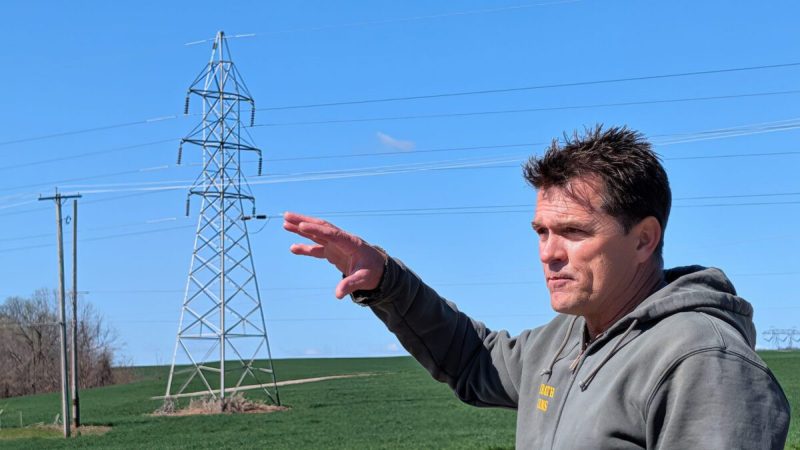
Most of the callers were speculators – “opportunists,” as Rexroth describes them – who, after viewing his farm on a map, believed it was the perfect site for a data center. High-tension power lines from the Brunner Island power plant and from TMI crisscross his farmland. The site atop the hill is also attractive for installing solar panels to provide for some of the power needs of a mega-data center.
He was wary.
Revenue for the township
But the more he learned about the issue, the more he thought it might be a good idea. The land, he said, isn’t going to be farmland going into the future – the economics work against it. “My goal is to hold onto it until I can be sure (whatever is built there is) the right thing for the community,” he said.
A data center, he believed, would provide needed revenue for the township. Its impact on the community would be minimal, as his property is fairly isolated and not surrounded by residential development. And of the options for the land, a data center would have less impact on the environment or the quality of life in the community than a giant warehouse or a sprawling housing development.
It just made sense to him. “It looked like it was the best thing for the community and the future,” he said.
But it didn’t make sense to others.
When word got out that data center developers were looking at Rexroth’s farm – and another farm in the township – the opposition was fierce.
Rexroth became a pariah.
The roads leading to his property are dotted with yard signs opposing data centers, the words “data center” under a red circle with a line through it, a symbol for “no.”
And he has attracted a lot of vitriol online. In person, he said, people tend to be more polite. “You don’t know what it’s like to have people giving you the finger as you go to church,” he said.
He just wants people to understand. He doesn’t want to do anything that would harm his community. He doesn’t want to do anything that would endanger the environment. He believes the data center would provide needed revenue to the township and Northeastern School District, easing the burden of property taxes for his neighbors. He would only sell the farm if he had assurances that the new owners would be good stewards of the land and would build the facility so that it had minimal impact on his neighbors. It has, he believes, the potential to do a lot of good if it’s done right.
Somebody, he said, is going to profit from the data center boom.
Why shouldn’t it be Conewago Township?
Blindsided
Jennifer Lynn Frye believes otherwise.
The home she shares with her husband, Bill Taylor, is a small rancher tucked into a one-acre lot carved out of the Rexroth farm, at the end of a lane off Bowers Bridge Road. The house used to be referred to as “the cop’s house” because a cop lived there years ago.
She first learned of the idea that she could become a neighbor of a massive data center in October 2025, less than a year after she and Taylor moved into the house. She heard about the possibility of a data center being developed in neighboring East Manchester Township and went to a meeting to learn more about it. At that meeting, someone mentioned to her that her home township was considering a similar proposal.
She looked into it and was surprised to learn that the proposal was in her backyard.
“The thought that they could rezone the land surrounding me was pretty shocking to me,” she said. “I began digging immediately.”
She did some research, and when she attended the planning commission meeting at Bible Baptist – speaking to express her objections – she was prepared. She listed her objections – the environmental concerns, the quality-of-life issues and other matters – and suggested that a data center would be better suited to an area already zoned for industrial use rather than an agricultural district. “That’s where it belongs, not on agricultural land,” she said. “Obviously, we’d love to see the land stay farmland. If that’s not an option, a park, something to serve the community. A pipe dream, perhaps.”
The planning commission meeting, Frye recalled, “was pretty … pretty heated. A lot of people spoke out of grave concern. People felt blindsided.”
She is concerned for the community. “A lot of us live in a rural area for a reason,” she said. “We like the quiet and the connection we have with our neighbors. To put a data center there, that doesn’t make sense. It seems to be a poor choice. Even a housing development would be better. We’d have more neighbors instead of a data center.”
She believes the township “looks at us as collateral damage to fix a mistake they made,” referring to the Freedom Square development. “I’m sorry if they made a mistake,” she said. “But we shouldn’t have to pay for that mistake.”
And she and her husband are concerned for their home. If a data center is developed on the land, she said, “We may lose our home.”
Still farmland … for now
For now, the 541 acres off Bowers Bridge Road is still farmland. The fields are covered with winter wheat, planted last fall and destined to be harvested around the Fourth of July. Then, Rexroth will plant corn in the fields.
And hope to make a small profit.