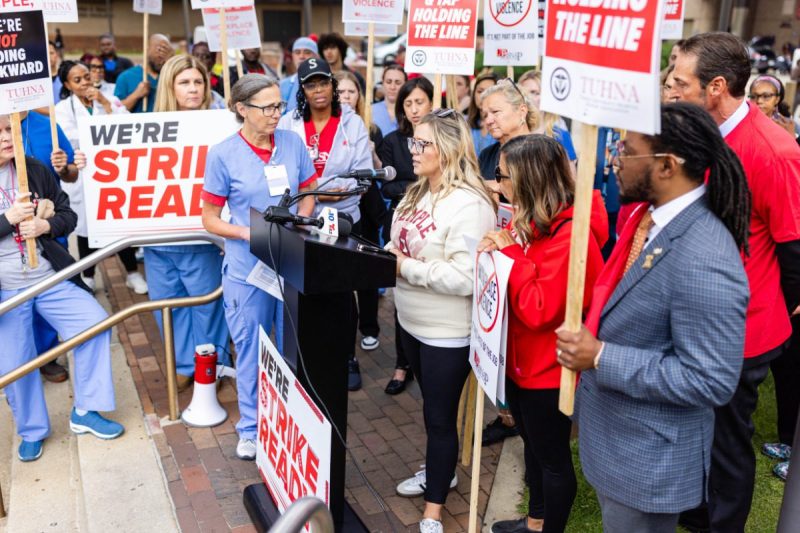
Two-thirds of Temple University Hospital nurses and caregivers have experienced workplace violence. Now, they’re getting ready for a possible strike.
Temple University Hospital may have a sign that says “Temple Heroes Work Here,” but caregivers and other staff members believe they aren’t being treated as such, especially when it comes to their safety.
Over 2,600 nurses, caregivers and other workers from Temple University Hospital and Temple Women and Families Hospital are preparing for a possible strike when their contracts expire at the end of September over higher wages, better health care benefits, and an increase in workplace safety.
Temple recently offered a 1% raise per year for three years and an increase in out of pocket expenses for co-payments, deductibles, and doctors or emergency room visits. In response, the nurses and caregivers scheduled a strike authorization vote, which gives the union leadership the ability to call a strike, on Sept. 19th.
“It’s funny. There was a sign that used to be out here that says ‘we’re heroes,’ but they treat us more like villains because the craziest thing is we’re not asking for anything outside of basic wages,” Carlos Aviles, a longtime Temple University Hospital Certified Pharmacy Technician and president of the Temple University Hospital Allied Health Professionals, told The Keystone in an interview.
Aviles added “nobody is gonna get rich here, but we also want to make sure, most importantly, that when we’re out here working we’re not dodging fists and bullets. We have too much uncertainty when it comes to our day-to-day operations and when you have to worry about people walking into your [Emergency Department] with gunshots or weapons sporadically on a weekend, that’s a problem.”
Workplace violence is so pervasive in the medical field that some nurses or caregivers are assaulted multiple times throughout their career.
An August 2025 survey of Temple University Hospital nurses found that 67% of respondents reported having personally experienced workplace violence at the main hospital, and 84% said they have witnessed workplace violence.
This includes threats, physical assault, sexual harassment, fluid exposure, dealing with weapons or dangerous objects like used needles or verbal harassment.
Nationally, 76% of hospital workers experience some form of workplace violence, according to the American Hospital Association. Their study found that 80% of hospital workers experience verbal violence while 33% experience physical violence.
Erin Pastore, an emergency room nurse at the main hospital for almost 10 years, has been assaulted by a patient six times throughout her career, with the most recent assault occurring on Sunday.
However, that wasn’t the worst assault she’s experienced.
“ I think the worst one was last year around Halloween. I was a normal night in the ER. A haste came over for a combative patient, security on standby,” Pastore told The Keystone. “He ended up in my room, security ended up leaving. They thought he was safe, and he ended up grabbing my arm, putting me behind my back, pushing me over the side rail, smashing my face into a mattress and threatening sexual assault.”
The attack happened in an instant, and luckily for Pastore, she was able to scream for help in a part of the ER where she could be heard.
“ After all the assaults and just the way things are, you would never treat a hero like that. You would want to help them, support them, give them what they need to get through the day.” Pastore added.
“I love working for Temple. I love the community, but Temple needs to come out from behind their closed doors and their desks and make it possible for us to say, ‘we’re proud Temple nurses.’”
Maureen May, a Temple University Hospital nurse and president of the Pennsylvania Association of Staff Nurses and Allied Professionals (PASNAP), explained that Wednesday’s pickets were the first steps in preparing for a possible strike.
She notes that any strike would begin as their contract deadlines come up toward the end of September.
“This is just the beginning of many actions that we will take in order to make sure that we get a fair contract and that contract extends to our patients,” May said.