Education advocates called on Pennsylvania lawmakers to close the $4 billion funding gap between poorer and wealthier school districts over the next four years. A 2023 report found that 387 of Pennsylvania’s 500 school districts have inadequate funding gaps.
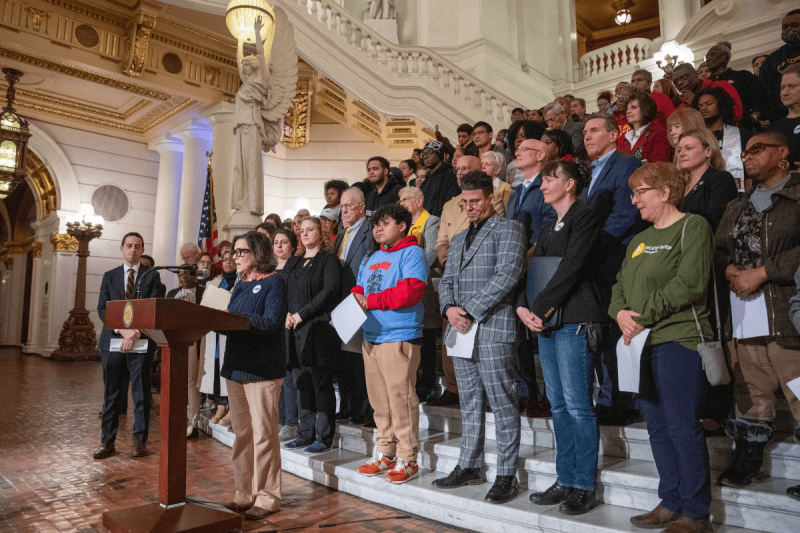
Education advocates gathered at the Pennsylvania state capitol in Harrisburg on Tuesday to call on lawmakers to close the commonwealth’s $4 billion education funding gap to properly fund the state’s poorest school districts over the next four years.
Inadequate funding between poorer and wealthier school districts, or an adequacy gap, can lead to educational resources not reaching students, limited ability to hire and retain qualified teachers, delayed facility repairs or the elimination of important school programs.
Last year, Gov. Josh Shapiro and the Pennsylvania General Assembly passed a $1.1 billion education funding increase that included nearly $500 million in adequacy funding for 348 underfunded school districts.
“Low wealth school districts in this commonwealth are owed $4 billion from the commonwealth of Pennsylvania, and the students of Pennsylvania are suffering as a result of that debt due to them,” Donna Cooper, the Executive Director with Children Fist said to reporters.
Closing the state’s funding gap has already had its benefits for students and teachers across the commonwealth.
“Across the state, districts are using adequacy dollars to avoid layoffs and to keep these vital programs going as millions of federal dollars are going away,” Susan Spicka, Executive Director for Education Voters of Pennsylvania, said.
Some examples of these benefits include: the Coatesville School District in Chester County reopened school district libraries that were eliminated four years ago, the Shenandoah Valley School District in Schuylkill County hired an art teacher and a social worker and invested in new computers, and the Altoona School District in Blair County is able to fund full-day kindergarten, language teachers and instructional support.
The efforts to close these funding gaps stems from the education funding lawsuit that was originally filed by the Public Interest Law Center and the Education Law Center on behalf of multiple school districts and education advocates across Pennsylvania in 2014.
The Commonwealth Court agreed on their behalf and issued an 800-page ruling in Feb. 2023 stating that Pennsylvania failed to meet its constitutional obligation to adequately fund public education.
A bipartisan Basic Education Funding Commission convened after the Commonwealth Court’s decision and established “adequacy targets” for each school district. It found a $5.4 billion adequacy gap on per student spending in 387 out of the state’s 500 school districts.
Spotlight PA reported on Tuesday that House Democrats support spending more money in the upcoming budget to close the funding gap while Senate Republicans want to review how last year’s funding was spent before committing to spending more money.
“Think for a minute about what it looks like when children go to kindergarten on the first day of school. Those anxious, happy little faces with the backpacks that are too large for them, right? Looking out at the possibility of what lies ahead.,” Dan Urevick-Ackelsberg, a Senior Attorney with the Public Interest Law Center, said Tuesday.
“The children who were in kindergarten when this case was filed are now in 10th grade. They’ve been in those underfunded schools this entire time. We need to get this done now.”