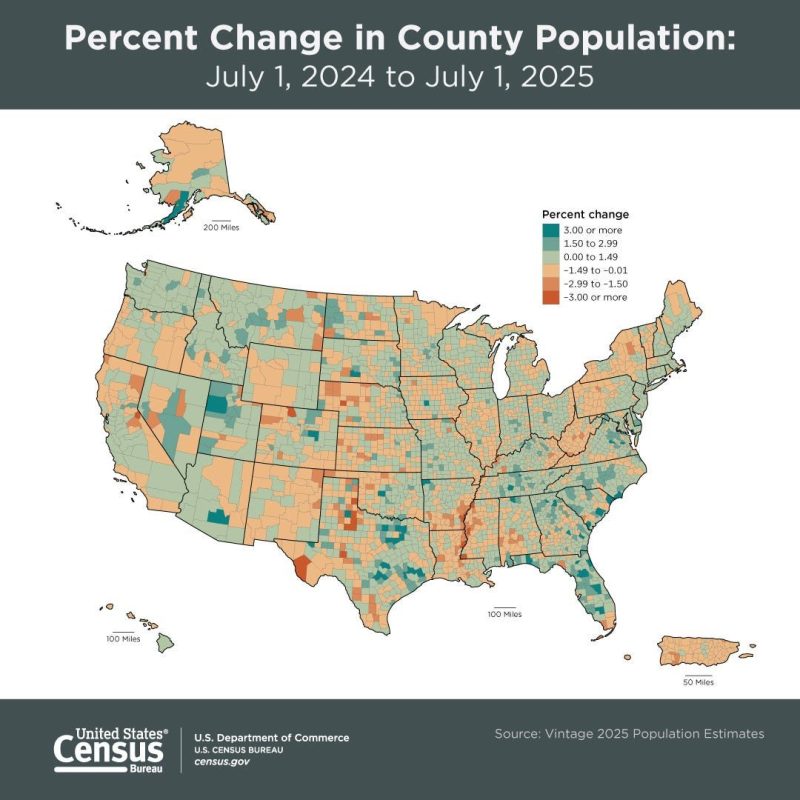
There are almost 57,000 more people estimated to be living in Pennsylvania than there were in 2020, and the state’s population has grown slightly since 2024.
Pennsylvania’s modest population growth is detailed in the latest U.S. Census Bureau report, published in March. It notes annual changes between 2024 and 2025 and cumulative changes from 2020 to 2025.
The Keystone State and 30 others gained residents since 2020 while 19 counties lost them. Pennsylvania’s 0.4% growth rate reversed a trend of declining population and outranked only Vermont’s 0.2% increase.
Measuring this starts with a base population that gets adjusted by adding births, subtracting deaths and accounting for net migration.
“A myriad of factors can affect the magnitude and speed of the changes,” according to the Census Bureau. “For example, economic uncertainty can affect attitudes toward fertility and mobility, a global pandemic can cause mortality to spike and policy changes can shape the number of people moving in or out of the country.”
How net migration has affected Pennsylvania
President Donald Trump’s aggressive immigration enforcement actions are believed to have influenced the United States’ first year of negative migration in decades, according to a report from the Brookings Institution.
Net migration accounts for international and domestic movement.
Pennsylvania’s net migration has been up since 2020, largely driving Pennsylvania’s growth since deaths have outpaced births here by roughly 89,000 since 2020.
The state’s international migration has brought in around 196,000 people while domestic migration in that period has seen roughly 54,000 people leave.
There are 41 counties in Pennsylvania that have lost total residents since 2020, with Philadelphia and Allegheny counties each losing more than 25,000 people. The next closest, Fayette County, lost more than 5,000 residents.
Seven counties grew by at least 10,000 people in that period, with Chester County’s nearly 22,000 leading the state. Montgomery, Cumberland, York, Northampton, Berks and Lancaster counties followed.
For an annual snapshot, 37 counties increased population from 2024 to 2025. Allegheny, Westmoreland and Centre counties each lost the most. Of the remaining 30 counties, 11 gained at least 1,000 people. With a 3,200-person increase, York’s annual growth was the highest. Cumberland, Chester and Montgomery counties all gained at least 2,000 people in that measurement year that.
Pennsylvania’s population forecast in 2050
The Center for Rural Pennsylvania, a nonpartisan research arm of the state General Assembly, reported in 2023 that the state would increase population by just 1.6% by 2050, with 46 of the state’s 67 counties losing population. As the USA TODAY Network has previously reported, the forecast notes that aging Baby Boomers, longer lifespans and declining birth rates are likely to leave communities increasingly older, with fewer workers and less tax revenue and strained under housing, services and infrastructure needs. Those forces would disproportionately affect rural areas, according to the center’s report.