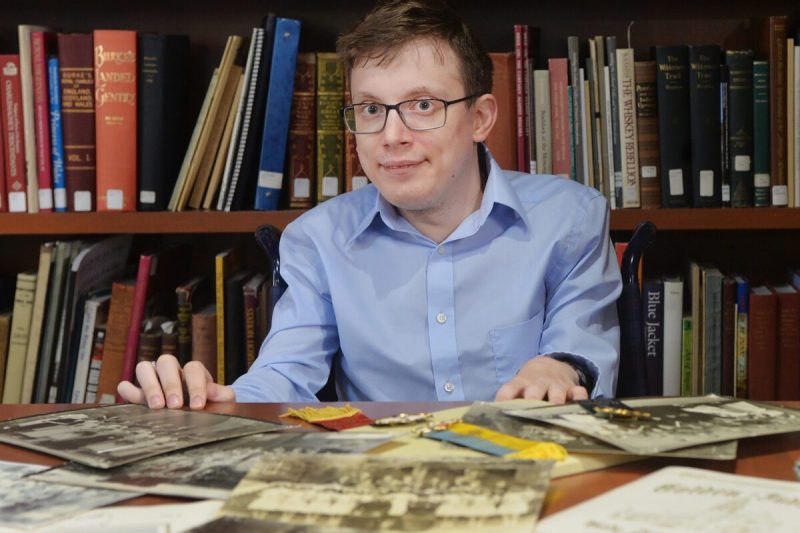
Bobby Sulecki has been researching the history of Erie’s Polish community since he was 12.
“My original intention, as a teenager, was to write a book on the Polish in Erie. There already were books on Erie’s Irish, Italians and other groups,” Sulecki, now 36, said. “But as I got older I kind of got out of it.”
Then Sulecki’s grandmother died and the Erie Catholic Diocese was looking at closing or consolidating churches. Families and churches had been the heart of the city’s Polish neighborhoods for decades.
“I thought, what’s going to happen to that history,” Sulecki said.
Sulecki resumed his research, now the foundation of a new Hagen History Center exhibit. “The Story of Us, Erie Polonia” opens on Oct. 1.
‘Erie Polonia’
Polonia, the Latin word for Poland, generally refers to Polish communities outside Poland.
In Erie and nationally, Polish immigration generally dates from the 1870s until World War I, Sulecki said.
Strongly Catholic, newcomers from Poland built churches in the neighborhoods where they settled. The “Erie Polonia” exhibit explores the founding of St. Stanislaus, Holy Trinity, St. Hedwig and St. Casimir churches, as well as the Polish National Catholic Church, which existed independently from the Roman Catholic Church until 1939.
“Especially for the Polish, your church, your parish was your identity,” Sulecki said. “It wasn’t just your religion; your whole life was involved in the church.”
Polish neighborhoods were named for their churches.
“Ask a Polish immigrant where he lived and he wouldn’t say, ‘East 13th Street’ but ‘St. Stanislaus district,’” Sulecki said. “The churches are still standing but the neighborhoods and that identity don’t exist anymore.”
“Erie Polonia” looks at the Polish community’s cultural and spiritual evolution to 1966 through personal stories, artifacts from Sulecki’s lifelong collection and items from the Hagen History Center archives.
The curator
Born and raised in Erie, Sulecki was introduced to the Polish language and culture by a great-grandmother who came from Poland.
Sulecki, who lives with cerebral palsy, was inspired by the family stories to learn more. His website, Erie Polonia History, was launched 10 years ago to share his research on the city’s Polish parishes, neighborhoods, businesses, clubs and people.
He now also writes a national blog, Heart of Polonia, focusing on the Polish-American community in Buffalo, New York.
Sulecki’s work earned a Trailblazer that Shaped Erie’s Historic East Side award in 2020, a certificate of appreciation from the Polish Falcons of America in 2022 and a Public History Award from the Hagen History Center in 2024.
Exhibit hours and admission
“The Story of Us, Erie Polonia” opens at the Hagen History Center’s Wood-Morrison House, 338 W. Sixth St., on Oct. 1 and continues through Jan. 30.
An opening reception with cake and coffee will be held Oct. 2 from 5 to 7 p.m. Admission to the Wood-Morrison House will be free for the event. All other buildings on the history center campus close at 5 p.m.
Sulecki will present a free program on Erie’s Polish community on Nov. 12 from 4:30 to 5:30 p.m. at the Hagen History Center’s Watson-Curtze Mansion. Advance reservations are required.
Exhibit hours will be Tuesday through Saturday, 10 a.m. to 5 p.m., and Sunday, noon to 5 p.m.
Hagen History Center admission, including admission to the exhibit, is $12 for adults, $10 for veterans, $7.50 for students and free for children 6 and under. SNAP EBT cardholders pay $3 each for up to four people through the Museums for All program. The center does not accept cash.