For more than half his life, Michael Abt has wondered every day why he’s alive.
His eyesight is failing. His hearing is shot. COPD makes it hard to breathe. The searing pain in his feet never leaves him for long.
He should have died 20 years ago after he was diagnosed with late-stage mouth cancer. But here he is. He made it through radiation without a feeding tube, something his doctor never heard of before.
Cancer isn’t the hardest thing Michael has survived. It’s not even a close second to the Friday 50 years ago when his family home was the scene of the worst mass murder in Bucks County history — a crime so notorious that people in Trevose still whisper his last name.
His parents, Jack, 49, and Peggy, 48, sisters Margie, 19, and Kathy, 12, brother Johnny Jr., 13, Margie’s boyfriend, Gary Engle, 20, and the family dog, a 10-year-old St. Bernard named Heidi, were found shot to death in the basement.
Only two Abt brothers were spared: Clifford, 23, who was in the Bucks County jail, and Michael, 21, who was late for dinner.
The brothers soon learned they were intended targets of the killer, a childhood friend who’d nursed a yearslong grudge that he extended to the rest of their family.
A half-century later, Michael is the last Abt left to tell his family’s story, though he’ll tell you he died that Friday, too.
“He killed seven people that day, it’s just that I didn’t stop breathing,” Michael said recently. “You wouldn’t believe the emotional changes I went through. I’m still going through.
“You’re never right after something like that.”
The Friday night that Trevose can’t forget
On March 12 of 1976, Michael, an asphalt paver laid off for the winter, left his home last on Fleetwood Avenue at 9:15 a.m. He was the last to leave that day.
After he cashed his unemployment check, he ate a burger at a nearby bar. From there he went to a dealership to buy a new car, a Ford Galaxie 500.
The rest of the day, he helped his best friend set up tables for a wedding reception the next day. Michael was his best man.
He knew he’d be late for dinner, so he called home to ask his mom to be sure to save him some of the fried fish they typically ate on Fridays.
“I kept calling and calling and calling. Nobody answered,” Michael said on a recent Tuesday in March as he sat on the couch in his Penndel apartment.
With five kids, the house was always Grand Central Station. His parents also regularly fed the their friends and other neighborhood kids who showed up at mealtime. Mom loved kids. She would have kept having them if she could.
Weirder still, when Michael pulled up to the house that night after 7 p.m., all the family cars were lined up in the driveway, but the four-bedroom split-level was completely dark.
The side door that everyone used was unlocked, and one of the window panes broken, but Michael said that neither struck him as alarming.
Until he walked into the kitchen.
“That is when all hell broke loose,” he said.
The silence is the first thing Abt noticed, and what looked like blood smears on the kitchen floor. He walked the few steps between the kitchen and living room and found a bloody towel on the piano bench. The carpet was soaked with blood.
Something was very wrong.
“You could feel it as soon as you walked into the house. There was a cold dead feeling. It was … it was bone-chilling,” he said.
“There is no describing the feeling. I just knew everybody was dead. You could just feel it.”
Abt ran around the house turning on the lights, yelling for his mom, dad, Margie, Kathy, Johnny and Heidi.
“No dog. No people,” he said.
Michael hid the ounce of marijuana he had on him before running to a house across the street. The neighbor told Michael he’d put his shoes on and come right over.
As Michael started back across the street, he saw another neighbor, David Clee, in his police cruiser. The Bensalem patrolman was headed home for dinner.
“I can’t find anyone,” Michael told Clee. “Where is my family?”
‘Madder than hell’
Later that night everyone in the Trevose neighborhood heard what happened to five members of the Abt family, Margie’s boyfriend, who also lived in Trevose, and the family dog.
David Clee found the bodies in the one room that Michael didn’t check: the basement.
After David Clee ordered Michael out of the kitchen, his wife, Donna Clee, took him to their house, where she had dinner on the table. Later, Michael said, the police took him to headquarters, where he was questioned about the murders.
But he said he had no clue who would want to kill his family. His parents were kind to everyone. They opened their house to anyone with nowhere else to go. The dinner table always had an extra seat, and plenty of people sat there.
Dad was a Boy Scout master who worked for the telephone company and raised chickens in the family’s backyard.
Mom worked for the IRS. She coached his sister Margie’s baton-twirling squad. A neighbor picked her as the godmother of her child.
Margie was a file clerk in Center City, and she dated Engle, who everyone called Gary, since high school. It was their second anniversary as a couple that day, and they were going out to dinner at the Rustler steakhouse.
The youngest two — Johnny, a Boy Scout, and Kathy, a student athlete — were in middle school.
Michael said that he and Clifford were the only ones in the family he thought that someone might have a beef with.
The brothers had a reputation for finding trouble. They hung out with some sketchy people, including members of the Breed, an outlaw motorcycle group that ran methamphetamines distribution in the 1970s.
“The only thing I could have thought of was drug-related,” Abt said. “Everybody loved my family. I couldn’t think of any possible reason other than drugs.”
Bensalem police knew that Clifford was involved in drugs. The night of the murders, they moved Clifford out of the county jail and into a holding cell at Bensalem police headquarters for his safety.
The police also initially suspected the deaths were drug-related, Michael said.
Everyone did, according to Ed Allahand of Trevose.
Allahand grew up on Hollywood Avenue, the street behind Fleetwood. At 70 years old, he still lives in Trevose not far from his childhood home.
He met Michael as kids. They’ve been friends ever since. He hung out with him, Clifford and other neighborhood kids, including George Geshwendt, who lived less than 100 steps across the street from the Abts.
People thought that Clifford made a bad drug deal and that the murders were payback, Allahand said.
After police released the house back to the brothers, Allahand went over there. Two girls were in the basement scrubbing blood off the concrete. Michael showed him the bullet holes in the wood paneling.
He also asked to borrow his shotgun, Allahand said.
But Michael said that he wasn’t afraid during the 10-day police search for the killer.
“Fear has no role in anything,” Abt said. “It was all rage. Anger and rage.
“I was madder than hell.”
George Geschwendt, the killer across the street
A little more than a week later, three Bensalem police officers and a Pennsylvania State Trooper showed up at the Abt house to deliver the news that they had a suspect in custody. Allahand was there that day.
The name of the suspect left him and everyone else in the room stunned, Allahand said: Police had arrested George Geschwendt, their childhood friend.
“Mike goes, ‘He couldn’t have,’” Allahand said.
The officers assured Michael that they had the right person. Geschwendt gave them a detailed signed confession.
Immediately, Michael bolted out of the house, screaming threats as he headed straight toward the Geschwendt house, Allahand said.
A Bensalem officer tackled him just as Clifford pulled up Fleetwood Avenue in the family station wagon.
Michael was screaming that George had killed their family. Clifford slammed the car into park and jumped out barreling toward the Geschwendt house, Allahand said.
Another officer stopped Clifford — not that it would have mattered. Police had already moved the rest of the Geschwendt family out of the house.
“I wanted to kill his whole family,” Michael said. “I just couldn’t imagine why. What possible reason could you have? I still don’t know. They were great people. What the hell did they do?’
Geschwendt was a quiet loner who grew into a strange quiet, loner, Abt and Allahand said.
The childhood friendship ended abruptly years earlier after Geschwendt and Clifford, then in middle school, decided it would be funny to stack wood and rocks on the train tracks, a place where neighborhood kids often spent time, Allahand said.
The next day Allahand heard an engine hit the obstacle causing major damage to the undercarriage. Geschwendt and Clifford and two others were arrested and charged as juveniles with vandalism.
The story goes that after the incident Mrs. Geschwendt ordered her son to stay away from the Abts. At the murder trial there was testimony the Abt brothers regularly bullied Geschwendt, but Michael denies it.
The last time he spoke to Geschwendt was three months before the murders, on Christmas morning Michael said. He and two friends were walking down Fleetwood Avenue and saw Geschwendt in his driveway, and stopped to chat.
“He was very distant. It was like talking to a zombie,” Michael said. “We were like, ‘He was strange.’”
Four months after the murders, members of a Bucks County jury convicted Geschwendt of six counts of first-degree murder and sentenced him to death. The sentences were commuted to life without parole after the Pennsylvania Supreme Court found the death penalty unconstitutional in 1977.
Geschwendt died in a Pennsylvania state prison of sepsis in 2020. He was 68.
At the time Michael was living in North Carolina. He didn’t find out that Geschwendt was dead until 2023 after returning to Bucks County.
For Michael Abt, every day is March 12, 1976
Kathryn Canavan was a 25-year-old Bucks County Courier Times reporter when she came to know Michael after his family was killed. They reconnected four years ago when she started writing a book about the infamous murders, “Killer in the House: 10 Days of Terror in a Pennsylvania Suburb.”
Michael joined Canavan at a recent book signing, where so many of the old Trevose people showed up it was like a reunion, she said.
“He was so happy. He seemed very, very up to see his old friends,” Canavan said. “And they seemed very happy to see him.”
Back then, Michael looked like the guy that parents warned you about with his wavy long sandy-blonde hair and horseshoe mustache. But he was usually polite and accommodating to the hordes of reporters and photographers clamoring to get his attention, Canavan said.
“His mom and dad raised him well, it was just a lot for a 21-year-old,” she said. “He has been through a lot, and I think anyone who gets judgy about Michael should think what would happen to you if that happened.”
With their family gone, it didn’t take long for the Abt brothers to lose everything else that gave them any sense of security.
A sheriff sale took the family home in 1984. At some point after, Clifford and a friend moved into the Geschwendt house, which was sold the month after the murder trial and turned into a rental property.
Clifford continued to struggle with drug addiction. He bounced in and out of jail over the next 13 years before he died, three weeks after his 37th birthday.
He’s buried in Resurrection Cemetery in Bensalem, nine miles from where the rest of his family is.
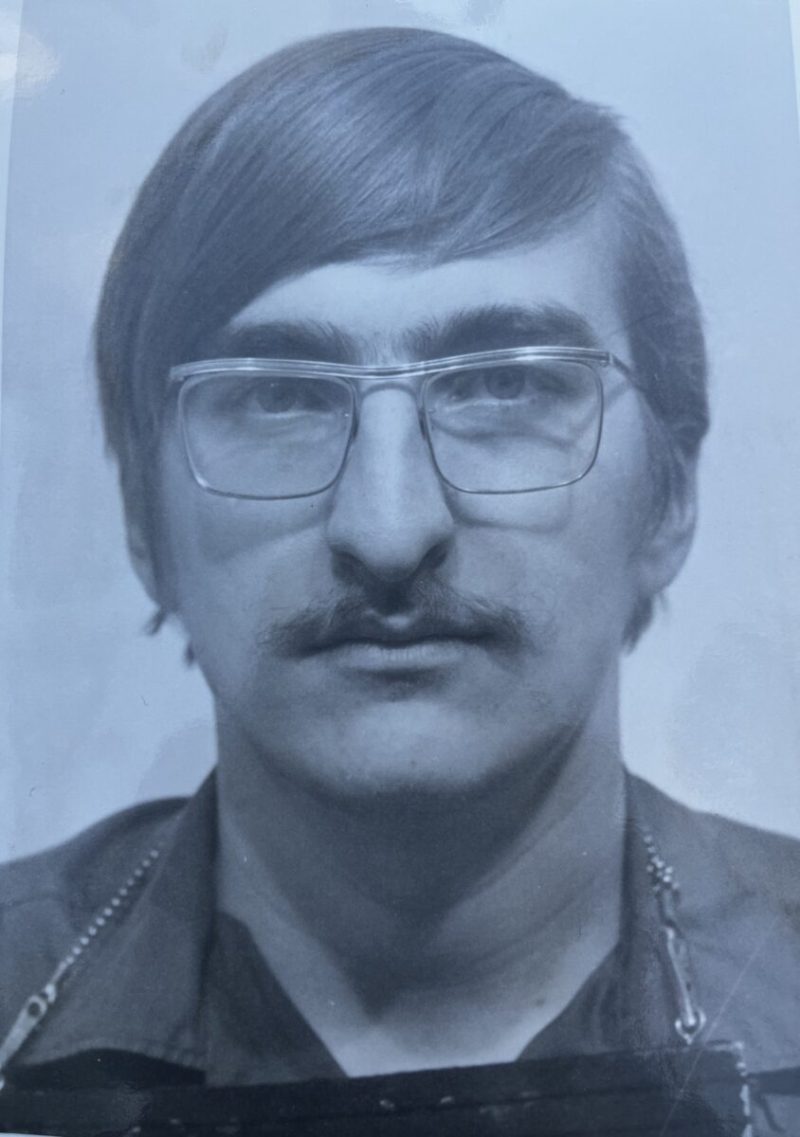
At 72, Michael speaks with a voice like tires hitting a highway rumble strip. What hair he has left is a shade of steel white and paired with a face clean shaven he bears a striking resemblance to his dad in 1976.
He has outlived the rest of his family. Most important to him is that he outlived Geschwendt.
“I swore I’d see him die,” he said.
What also gives him satisfaction, Abt said, is knowing that years into his life sentence Geschwendt wrote to the Common Pleas judge, the district attorney and Bensalem police chief asking to be put to death.
Michael is remarkably candid talking about his life since the day, his poor choices including jail and homelessness, and the memories no amount of drugs or alcohol has been able to stop playing in his mind.
“You know how many times I’ve been hospitalized for suicide attempts? At least a dozen I was hospitalized for. I’ve had my share of mental bumps and bruises,” he said.
Fifty years have passed. But for Michael, every day is March 12, 1976.
“You can’t move forward. Well, you can, but you’re dragging that weight with you. You drag that everywhere, all the time,” he said. “For some reason I keep bouncing back, I don’t know.
“I would just as soon lie down and not wake up because waking up scares me more than that. … I just pray the good Lord has a spot for me so I can rest in peace.”