High school football and construction work have taken their toll on Justin Loebel’s back.
Though he is just 43, Loebel has already undergone fusion surgery to alleviate chronic back pain. It didn’t help and Loebel was forced to stop many of his favorite activities, including working out.
“It would hurt even if I was just standing or walking,” Loebel said. “I could feel my spine grinding when I exercised. I was limited in what I could do.”
Loebel, who lives in Lockport, New York, believed there was a better option available. One of his doctors said there is a new surgery, approved by the Food & Drug Administration in 2024, that might help.
It’s called lumbar facet joint replacement and it involves replacing the small joints in the back of the spine that allow you to bend and twist.
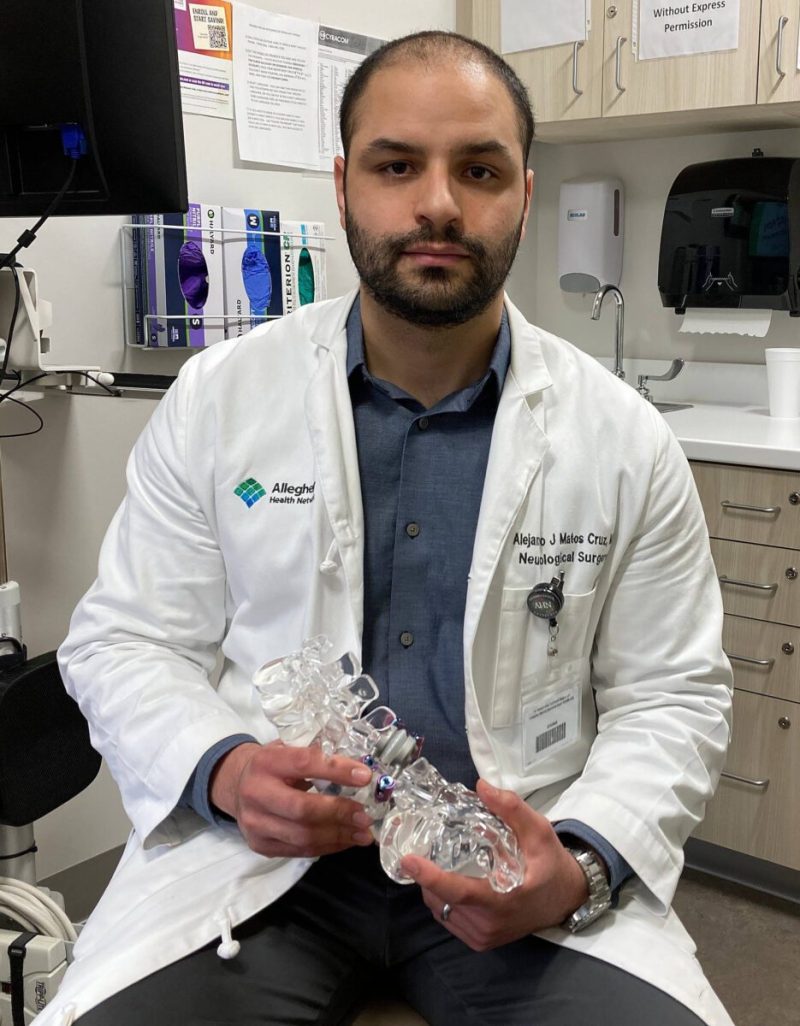
“It is an alternative to fusion surgery in some cases,” said Dr. Alejandro Matos Cruz, a Saint Vincent Hospital neurosurgeon who performs the surgery. “It helps keep a patient’s full range of motion, which is affected when you do fusion surgery.”
The problem was that none of the surgeons in nearby Buffalo were doing the surgery. His neurosurgeon, who was preparing Loebel to have another fusion surgery, recommended that he see Dr. Donald Whiting at Allegheny General Hospital in Pittsburgh.
Loebel’s health insurance wouldn’t cover the surgery
Whiting told Loebel that he was a candidate for the surgery and that Dr. Matos Cruz was starting to perform them at Saint Vincent in Erie.
“The only problem was that my health insurance wouldn’t cover the surgery,” Loebel said.
Surprisingly, Loebel has Highmark Blue Cross Blue Shield, the insurer that owns both Allegheny General and Saint Vincent.
A Highmark spokeswoman said that some Highmark plans in some markets do cover lumbar facet joint replacement.
“Coverage can often depend on the plan the individual patient has, and we recommend patients call the number on their insurance cards to find out if they are covered,” the spokeswoman said in an email.
The lack of coverage didn’t deter Loebel, who decided to pay the $15,000 cost out of his own pocket.
Loebel underwent the minimally invasive surgery in September. Matos Cruz removed the facet joints in a rear section of Loebel’s lower back and replaced them with the matchbox-sized prosthetic.
“This device is made to allow your lower back to move naturally,” Matos Cruz said. “With fusion surgery, it’s locked in place. The device also better protects the adjacent level of the spine because it absorbs the mechanical stress of bending or moving instead of it getting passed up the spine.”
‘Don’t be a knucklehead’
Facet joint replacement isn’t the answer for everyone with lower back problems. Patients need to have well-preserved spinal discs and the problems need to be focused on the back part of the spine, Matos Cruz said.
Loebel’s recovery was quicker than his previous fusion surgery. Instead of no heavy lifting for up to three months, he was just told to take it easy for a few weeks.
“What I tell patients is, ‘Don’t be a knucklehead,’” Matos Cruz said.
Loebel followed his doctor’s advice and has since resumed his traditional exercise routines, including lifting free weights, running on the treadmill and climbing on the Stairmaster.
How long will the device last? Matos Cruz said the prosthetic is so new that no long-term studies have been done.
“The only question is whether I will have to get it replaced in 20 years or so,” Loebel said.