Erie is looking to its past to help shape its future.
The centerpiece of that effort — a plan backed by a key mover behind the $420 million World War II Museum in New Orleans — is a proposal to build a state-of-the-art War of 1812 Museum in Erie.
And that’s only part of what’s under consideration as efforts to reconstruct 18th century forts on Erie’s east bayfront advance.
The goal is to grow heritage tourism while celebrating local history.
“Heritage tourism is a very key component for community and economic development,” said Tom Tupitza, a volunteer with the Three Forts initiative. “And Erie has got many more historic resources to build on than lots of other communities.”
Nationally, museums contribute $50 billion to the economy each year, according to Forbes.
‘Most crucial spot in War of 1812’
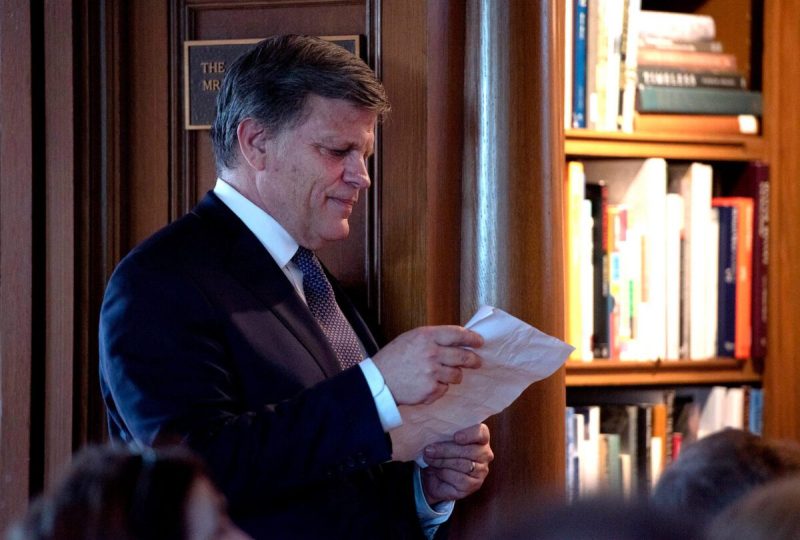
There’s no better place than Erie for a War of 1812 museum with national reach, said historian Douglas Brinkley, who proposed the museum.
“Erie, Pennsylvania, was the most crucial spot in War of 1812 history because of the building of the American fleet there,” Brinkley said. “Ships like the Lawrence and Niagara created an inland navy that was able to defeat the British at the zenith of their naval power.”
The American defeat of the British in the September 1813 Battle of Lake Erie under the command of Oliver Hazard Perry was vital to winning the war, cementing American independence and opening the West for expansion, Brinkley said. The British were using Lake Erie to control Detroit, the Michigan territory and land further west.
“It was nothing less than a showdown on whether the United States would exist or not when the Battle of Lake Erie commenced. And what Oliver Hazard Perry did in that battle wouldn’t have happened without Erie, Pennsylvania,” Brinkley said.
Brinkley is a Perrysburg, Ohio, native, and grew up learning about Perry and the Battle of Lake Erie. He is a professor of history at Rice University in Houston and is the author of bestselling histories including “American Moonshot,” “Cronkite” and “The Nixon Tapes.”
He helped colleague Stephen Ambrose develop the D-Day Museum, now the National World War II Museum, in New Orleans. The popular website Tripadvisor ranks the museum as the top tourist attraction in New Orleans.
‘Don’t give up the ship’ attitude
A feasibility study for the proposed War of 1812 museum will be done by Lord Cultural Resources of Toronto, Ontario. The firm’s projects have included work on the National World War II Museum and the U.S. Capitol Visitor Center.
The local study was commissioned in January by the nonprofit Jefferson Educational Society.
The concept for a “state-of-the-art, 21st century” museum has been shared with local government and community leaders. Ideas for its location, design, cost and operations will be shared once the feasibility study is complete. The museum could be operated by the National Park Service. Or it could be operated privately or by the state, said Erie native Steve Scully, who is working on the museum initiative with Brinkley and the Jefferson Educational Society.
“We will meet with all the stakeholders and say, ‘Here is the concept and what it will take and here’s how we will go about doing it.’
“We’re going to get it done,” Scully said.
An award-winning broadcaster, political editor and senior executive producer for C-SPAN for three decades, Scully hosts “The Briefing with Steve Scully” on Sirius XM. He is a member of the Jefferson Educational Society administrative team and chairs the society’s annual Global Summit in Erie.
Brinkley agrees that the museum will become reality.
“We’re approaching this with a ‘we can do it, don’t give up the ship’ attitude,” Brinkley said.
The ‘Three Forts’
Three successive forts guarded the Erie frontier in the latter half of the 18th century.
Fort Presque Isle was built by the French in 1753 and abandoned in 1759 during the French and Indian War. The fort was rebuilt by the British a year later and was captured and burned during Pontiac’s Rebellion in 1763.
An American fort and the original Wayne Blockhouse honoring General Anthony Wayne were built at East Second and Ash streets, where the rebuilt blockhouse stands, after the Revolutionary War. Wayne died at the site in 1796.
Rebuilding the forts was first publicly proposed by researcher and writer Michael Fuhrman in 2018, in a Jefferson Educational Society essay and program.
“Erie is one of the only places in America where forts of all three nations had a footprint, and they’re fairly close to each other,” said Jefferson Educational Society President Ferki Ferati. “So we conducted a historical essay, and as we do with most initiatives, and let the community decide if it wants to take the idea further.”
A master plan for the project — also highlighting Native American and immigrant history in the area — was completed by Encore Interpretive Design of Nashville in October 2021 with funding from the Jefferson Educational Society, Erie Community Foundation, Erie County Gaming Revenue Authority and Bayfront Eastside Task Force. A separate feasibility study is nearly complete.
The forts complex would be built in three phases beginning with the creation of a Memorial Park on the site of the American fort on Garrison Hill — on the grounds of the Pennsylvania Soldiers and Sailors Home — plus Wayne Blockhouse restoration.
“We all remember visiting the blockhouse with school classes,” Tupitza said. “It’s still available but is under-utilized. We hope to make it more visible and accessible.”
Tupitza is an Erie lawyer who has served in key roles with the Erie County Historical Society, Erie Regional Chamber and Growth Partnership, VisitErie and other community organizations.
Second-phase work on the project would include reconstruction of the French and British forts, or some part of them, nearby. Third-phase work would focus on opening an interpretive center.
Organizers are working with state and local government leaders and the Pennsylvania Department of Military and Veterans Affairs. They’ll also work with local historical organizations to ensure that the complex complements what’s being done by existing museums and what’s planned by the War of 1812 museum.
“We want to make sure that we’re working collaboratively with everybody who has similar interests and are not duplicating their efforts,” Tupitza said. “We have such a wealth of historical resources here. We want to make sure we capitalize on them in the most efficient way.”
‘It would put Erie on the map’
The proposed War of 1812 museum and forts — with the Hagen History Center, Maritime Museum and Flagship Niagara — would grow Erie as a destination for heritage tourists, including tourists interested in naval history, said Nick Scott Sr., president of Scott Enterprises.
“Essentially, Erie is the birthplace of the U.S. Navy, which commissioned the building of Perry’s fleet in Misery Bay,” Scott said.
Scott named Oliver’s Rooftop restaurant — atop Scott Enterprises’ Hampton Inn & Suites hotel on Erie’s bayfront — in Perry’s honor.
A War of 1812 museum and reconstructed forts would be “very meaningful” for the city, Scott said.
“It would put Erie on the map for historical tourism and enlighten a lot of people unaware of the details of our history.”
The museum and fort initiatives are more than wishful thinking, Ferati said.
“Big things can happen in Erie. We shouldn’t have any doubt about that. They just take a little energy, which we’ve had over the last decade. And we’re already seeing the changes.”