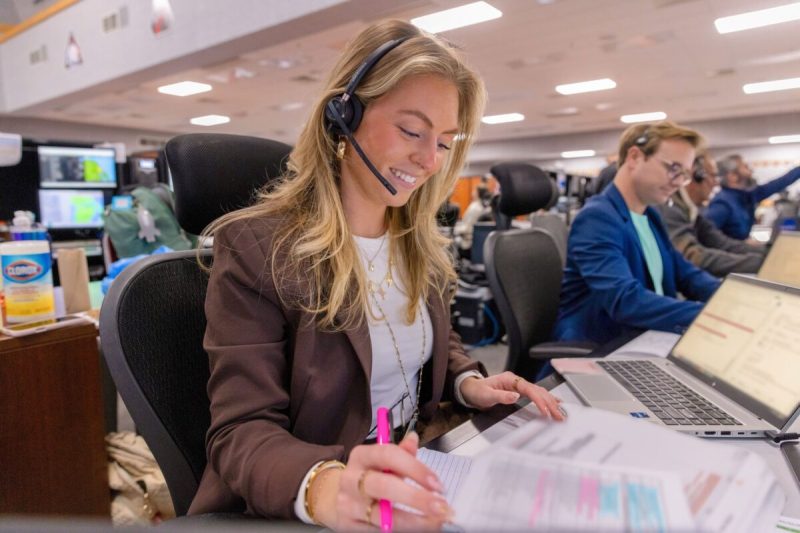
“T-minus 10” was announced over the intercom on April 1, and a Dover Area graduate found herself holding her breath as she watched two years of preparing for these final moments take off.
At T-minus 33, the automated launch programs, from which there was no turning back at that point, kicked on. But it all resulted in the first successful manned moon launch in over 50 years as four astronauts and Artemis II hurtled away from Earth.
Madison Schmaltz, 24, who graduated from Dover Area High School in 2019, recalled asking herself if the launch was going to happen.
“The room is dead silent and no one’s breathing,” Schmaltz recalled at the 10-second marker. “Everyone’s holding their breath.”
She said adrenaline powered her through the morning, which started around 1 a.m., but that changed when the launch got closer.
“I’m sitting there shaking, and it’s like ’cause you don’t know,” she said. “The amount of uncertainty of where it is going to go is so overwhelming.”
Schmaltz said that’s when the nerves and stress kick in. She didn’t know if she should sit, look around or just focus on her screen in front of her.
She remembers shaking and holding her breath as she watched the rocket take off, as the windows shook from the force, concerned that a shoe might drop. She continued to hold her breath until the astronauts were safe.
She added that the windows shaking wasn’t a scary sound because it’s a common event, as the Kennedy Space Center isn’t far from the SpaceX launch site, which launches frequently.
But it was different that day because it was NASA’s rocket, which she aided in helping it get it launched.
“It’s in the sky, like the first try it’s up there,” she recalled about her emotions from her first rocket launch. “It’s going. It’s happening.”
The windows shaking was almost what she experienced as a child when her parents took their family on a tour of the Kennedy Space Visitor Center. The windows shook in one of the rocket launch simulations, which made her cry.
She later learned that she cries when she’s so excited and passionate about something because she doesn’t know how else to process it.
During the Artemis II launch, Schmaltz felt that same passion. She said she didn’t know if she wanted to scream, cry or throw up because of all the emotions she was feeling as an adult.
But during that simulation rocket launch was when she knew she wanted to join NASA’s mission and worked hard for it. Schmaltz hit roadblocks and confessed she struggled with math. There were a few times she wanted to quit when she was attending Embry-Riddle Aeronautical University in Daytona, Florida. When she hit blocks, her mom kept encouraging her to shoot for the stars.
Now that her daughter has done just that, Schmaltz’s mom wrote her a card saying how proud of her daughter she was.
“They always knew I had big expectations of myself to get somewhere big when I was growing up,” she said. “I just don’t think any of us expected it to happen so soon.”
When she graduated from college, Schmaltz hit another hurdle: getting a NASA job. She struggled with employers wanting her to have experience even as a fresh college graduate. She applied to multiple openings and even looked at other companies outside of NASA, but her heart was always set on the space agency.
It was one of her professors who reached out to her ex-husband to ask to get Schmaltz’s resume looked at.
In 2023, Schmaltz’s dreams came true when she was hired as a contractor test conductor, and a year into her employment, she learned she was going to be a member of the launch staff.
On a day-to-day basis, the Artemis test conductor is involved in operations of building rockets, testing them and ensuring systems are functioning, whether it’s the ground, rocket or astronauts’ systems.
For launch day, she arrived at the office around 1 a.m. for her main focus that morning: moving the mobile launcher, which is the item the rocket sits on. She wrote the procedure and directed the drivers on when to move the crawler from the Vehicle Assembly Building to the launch pad. She was the one who made sure the rocket was moved on time.
From “T minus four hours and something minutes” to launch, she was the ground test conductor, which means she made sure the ground systems were doing what they should be doing. If there were problems, she would report them up the chain to those ahead of her. She described her job as helping with the flow.
While she didn’t get to talk to the astronauts directly on launch day, she did get to meet them and shake their hands. She also got to hear them during the countdown, but it wasn’t her assignment to talk to them.
Once the launch was over, the Houston Space Center took over control, which she said she was happy about because she was able to breathe then.
“It was a lot leading up to that point,” she said.
That center will also be the one in charge of returning the astronauts to Earth on Friday, on the other side of the country, which she is hoping to watch. She logs into NASA’s livestream when she can now. She said they all do because they are keeping an eye on the four astronauts.
Schmaltz said she’s pretty excited for Artemis’s safe return trip.
“Because that means all of our hard work, that’s building a rocket, was successful, and that means we’re going to keep going,” she said. She said there is a push to launch another rocket next year, which they are already gathering parts for.
As for her future, she has no plans of becoming an astronaut. It’s tight quarters and not for her.
“I will probably stay here on the ground and launch it for them,” she said.
Rather, she might work to become a custom conductor that’s higher up the chain.
In the meantime, she’s enjoying the ride and feels like a child in a candy shop because of how much she loves the dream that came true.
Now she gets to look at the Vehicle Assembly building, which is where they build the rockets and one of the buildings she saw on a tour as a child, on her way to work.