Approximately 6,000 Penn State University professors and faculty members are ready to vote in the largest public sector union vote ever in Pennsylvania.
Professors and faculty members from Penn State University and its network of sprawling satellite campuses across the commonwealth made history on Tuesday by filing for the largest public sector union in Pennsylvania’s history.
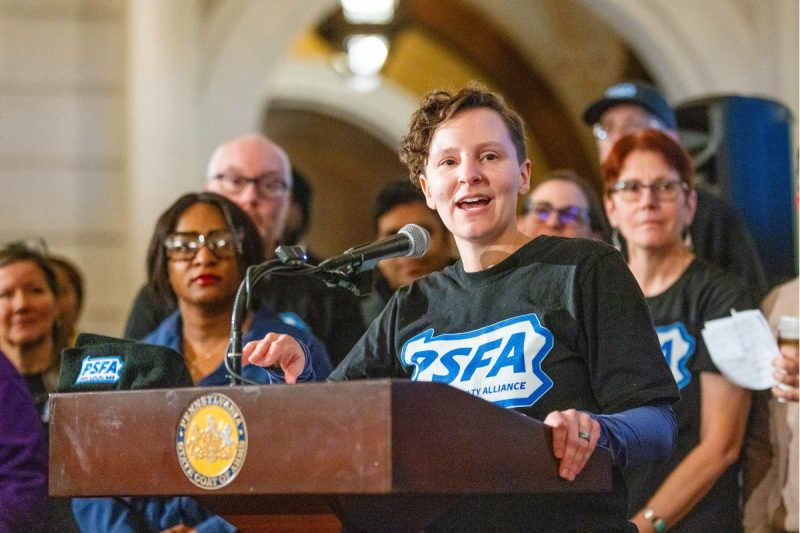
Members from Penn State Faculty Alliance gathered in the Pennsylvania State Capitol on Tuesday to announce that it has obtained enough signatures to have a union election and is calling on the administration to host a fair and speedy election.
“ This filing of this election will be for approximately 6,000 Penn State faculty and associated positions, which will be the largest single union election in the public sector in the history of the Commonwealth, if not the last 50 years,” Steve Catanese, President of Service Employees International Union (SEIU) Local 668, said during Tuesday’s press conference.
He added, “ Penn State faculty are filing for a union election to bring transparency to their workplace, to bring job security to their workplace, to have the opportunity to have a greater voice at their workplace, to have some economic security at their workplace.”
Penn State Faculty Alliance went public with its organizing efforts last February when it was collecting union authorization cards from professors and faculty members, and if successful, it is looking to unionize with SEIU Local 668, which represents 20,000 county and state workers across the commonwealth.
Nationally, SEIU represents over 54,000 professors and faculty members spanning 60 campuses.
“When major decisions happen, be it closures of campuses or massive system-wide buyouts, those workers should have a voice and that voice can come through their process in their union and their right to bargain and negotiate over wages, benefits, the terms and conditions of their employment,” Catanese said.
Last month, Penn State graduate student workers voted 90% in favor of unionizing with the United Auto Workers (UAW) so they could have legal workplace protections and better compensation.
Kate Ragon, an Assistant Clinical Professor of Labor and Employment Relations at Penn State’s main campus, explained how her colleagues’ stories and frustrations played a role in organizing the school’s faculty.
”I also heard a lot of frustration, a lot of disappointment, and even anger about the conditions of their work,” Ragon said. “As a teacher, I know that my working conditions are my students’ learning conditions. That’s why we are forming a union because we want a voice in the decision making that affects us, affects our students, and affects our work.”