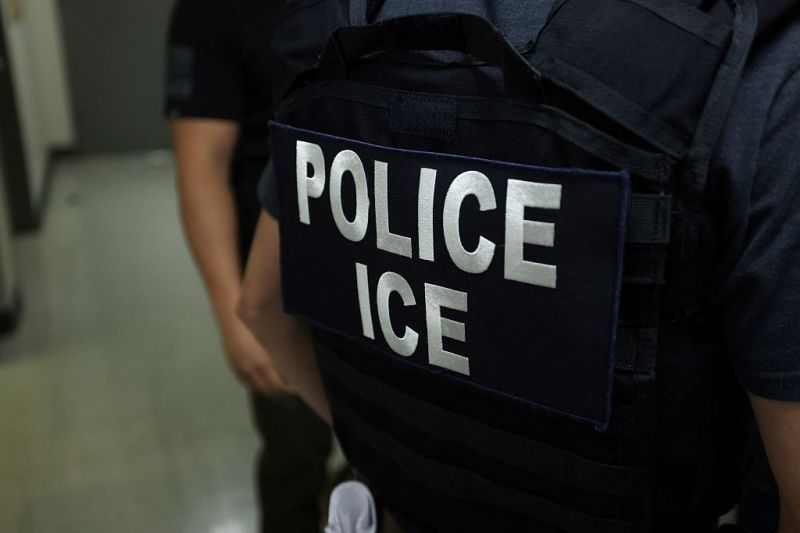
The measure would apply to ICE and a growing number of local law enforcement agencies under contract with the federal agency.
Civil immigration arrests would be prohibited within 1,000 feet of state-owned or leased facilities absent a judicial order or warrant under a proposal being developed in the Pennsylvania Senate.
The move comes in response to increased “warrantless immigration arrests in places that should be safe” by Immigration and Customs Enforcement (ICE) officers, according to a cosponsorship memo from state Sen. Amanda Cappelletti (D-Delaware/Montgomery).
“This has created a chilling effect,” Cappelletti wrote, “discouraging residents from seeking essential services, frightening our communities and undermining public trust in our government.”
Her proposal comes days after demonstrations nationwide over a fatal ICE shooting encounter in Minneapolis. It also follows months of mounting outrage over the surge in arrests and detentions by immigration officers during the past year under the Trump administration, often without due process and in some cases resulting in U.S. citizens being taken into custody.
The memo dropped just before President Donald Trump’s pledge Tuesday to withhold federal funding from “sanctuary cities or states having sanctuary cities.” It wasn’t immediately clear what that would mean for Pennsylvanians, given differing interpretations of the classification among sources including the Department of Justice and the Center for Immigration Studies.
A spokesperson for Gov. Josh Shapiro said the governor won’t “hesitate to go back to court if funding for Pennsylvania is threatened.”
Shapiro’s office has initiated or joined a number of lawsuits during the past year seeking frozen funds from the Trump administration. State Attorney General Dave Sunday, whose office would traditionally lead such litigation, did not immediately respond to a request for comment.
Cappelletti highlighted New York, Illinois, Connecticut and Washington as states that have similar rules in place; Oregon, Vermont and California do, too.
Each of those states had already enacted other laws governing ICE cooperation, which Pennsylvania has not, including restrictions on local law enforcement entering agreements with federal immigration officials. There’s active litigation in New York over counties allegedly running afoul of state law there for arrangements formalized in recent months.
Fifty-two agencies in the commonwealth have such contracts in place, according to the federal government, more than double the number as of last summer. They’re known as 287(g) agreements after the section of U.S. Immigration and Nationality Act that provides for the delegation of specific ICE functions to state and local law enforcement.
Three took effect last week for police departments in Coraopolis, Allegheny County; East Franklin Township, Adams County; and Kittanning, Armstrong County, federal records show.
Cappelletti told the Capital-Star her proposed restrictions on civil immigration arrests would extend to police and other non-federal agents.
“If you are acting to enforce immigration policy and law, you must have a judicial warrant or order to enter a state facility. And it’s that simple. Whether you’re an official ICE agent working for the federal government or you’re working through that contract, it’s the same principle,” Cappelletti said Tuesday. “If you choose to enforce it elsewhere, that’s another question.”
The GOP-controlled Senate has passed bills before aimed at fostering – rather than limiting – cooperation with federal immigration authorities.
Lawmakers have advanced proposals to ban or restrict sanctuary designations on multiple occasions during the past decade.
Last spring, a measure to require ICE notification when undocumented immigrants commit crimes passed the chamber and has since stalled in the Democratic-majority House.
And SB1021 to enhance penalties for offenses against immigration officers, meanwhile, awaits consideration by the state Senate Judiciary Committee.
Cappelletti said she hopes her colleagues “see the need to ensure that our federal law enforcement officers are indeed acting within the bounds of their duties and within the law.”
“Currently, we know that that is not happening, and it’s creating a lot of terror in our communities,” she said.
Asked about potential Republican support, Senate Majority Leader Joe Pittman (R-Indiana) said through a spokesperson that his caucus will continue to focus on safety and security of communities in the commonwealth.
“Collaboration between state and federal government is critical as we work to recover from the disastrous border policies of the Biden Administration and seek to protect lawful citizens,” Pittman said.
Cappelletti said she intends to introduce her legislation soon. Some details still are being finalized, including what would qualify as a state facility.
“It’s very clearly going to include anything that the state owns or leases or that a state entity uses. And that’s a government agency, a public authority or board where the governor or the executive office has appointed the chairperson or the majority of the board members, things of that nature,” Cappelletti told the Capital-Star. “We have those definitions in place. And we’re just looking to see how expansive we might be able to be, or how limited we have to be, depending on case law.”
State Rep. Manuel Guzman (D-Berks), who’s pushed previously to limit ICE detention and cooperation in Pennsylvania, said he’ll introduce a companion measure in the House.
“Communities … should be able to access state services without fear of unjust enforcement,” Guzman said in an emailed statement. “We must safeguard our communities, uphold Pennsylvania’s authority over its own facilities, and ensure the dignity, safety, and rights of every Pennsylvanian.”
Lawmakers return to Harrisburg Jan. 26.