A handful of Republicans joined all 102 Democrats to advance the measure.
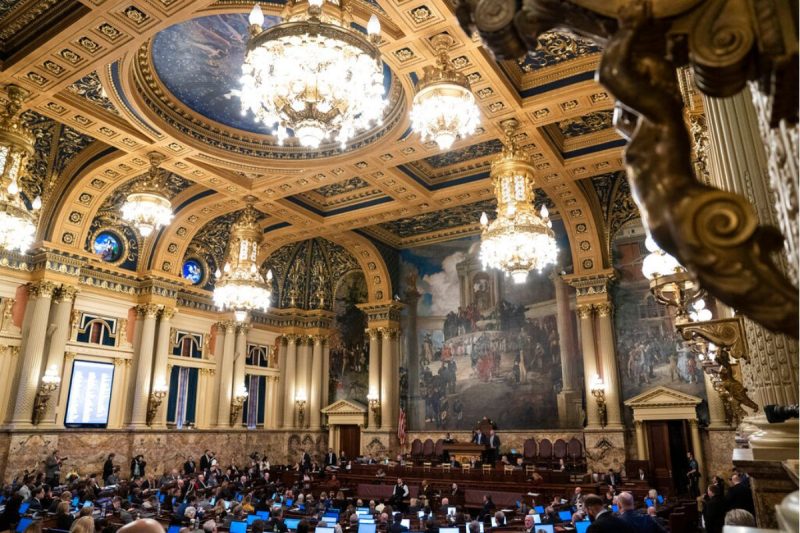
Three weeks after introducing an identical $53.2 billion spending plan to Gov. Josh Shapiro’s proposal, state House lawmakers passed the unaltered budget Tuesday, sending the bill over to the Senate for further consideration.
A handful of Republicans joined all 102 Democrats to advance the measure on a 107-94 vote, which calls for funding part of the 5.4% increase over last year’s plan through taxes on legalized recreational cannabis and electronic skill games — which have been included in previous budgets and rejected annually by Senate Republicans.
“This budget continues our investment in public education, support for law enforcement, and strengthening Pennsylvania’s economy, all while returning money to working families and not raising taxes,” said House Appropriations Committee Chair Rep. Jordan Harris (D-Philadelphia) in a statement. “Our focus remains clear: getting a responsible, balanced budget done on time that makes Pennsylvania more affordable and continues to deliver on our commitments to communities across the Commonwealth.”
Though Democrats hold the governor’s seat and House — the latter with just a one-seat majority — Republicans hold a slim majority in the Senate, meaning all parties must come to a consensus. Negotiations stretched past the June 30 deadline last year — as they have for six of the last ten years — and the budget was finalized 135 days late, leaving counties, schools and nonprofits in a financial lurch.
Harris previously vowed to avoid a delay this year, emphasizing the need for an on-time budget in his statement.
Republican feedback
But the majority of Republicans are critical of the proposal’s spending, warning that a “day of reckoning” would be coming to the Keystone State, pointing to a $6.7 billion structural deficit, or the gap between the state’s predicted revenues and expenses.
That number doesn’t include new taxes included in Shapiro’s proposal. Of particular concern for Republicans was a bid to use dollars from the state’s $7.5 billion rainy day fund to balance the budget.
“If last year’s budget process was a fiscal crisis, this year’s budget process has the potential to be a fiscal nightmare,” said Rep. Tim Bonner (R-Mercer). “(Shapiro) now proposes a budget that will deplete 60% of the rainy day fund, depleting it to approximately $3 billion. Our reserves will be totally exhausted by the end of the next fiscal year, and we will then be asking our citizens to support a tax increase.”
In a release shortly after the bill’s passage, Senate Republican leadership panned the proposal in a joint statement from Senate President Pro Tempore Kim Ward (Westmoreland), Senate Majority Leader Joe Pittman (Bedford) and Appropriations Committee Chair Sen. Scott Martin (Lancaster).
“We continue to have profound concerns about the level of spending in the budget proposed by Governor Shapiro and passed by the House today. Moving a budget plan forward is an important step in the process, but much work remains to reach a final agreement which respects taxpayers both now and in the future. We will continue to fight for a more fiscally responsible spending plan that better positions our Commonwealth to grow and prosper, without placing unreasonable financial burdens on Pennsylvania families and taxpayers.”
Senate leaders will now have the opportunity to introduce their own version of the budget for the next fiscal year.
Nearly 80% of the budget’s expenditures are dedicated to just two state agencies: the Department of Human Services with $21.9 billion and the Department of Education with $20.6 billion. Roughly $1 billion of the increase to DHS will fund Medicaid increases, which Democrats said will shrink if the state increases the minimum wage from $7.25 per hour — the federal minimum — to $15.