Nationally, there are over 2,600 crisis pregnancy centers, with close to 160 located in Pennsylvania. More than 75% of these centers are linked to religious, anti-abortion networks.
When one of Dr. Alhambra Frarey’s patients walked into what she thought was a medical clinic in Philadelphia, she was looking for help. She’d recently found out she was pregnant and wanted to learn more about her options. Instead, staff at the “clinic” told her she had already miscarried and sent her home.
Later, after still experiencing symptoms of a pregnancy, she visited Frarey, who has been providing reproductive health care services in the Philadelphia area for a decade. The truth was shocking.
“She came in thinking she had a miscarriage,” said Frarey, chief medical officer of Planned Parenthood Southeast PA. “We had to explain that she actually had a viable pregnancy.”
It wasn’t the first time Frarey had heard about the false clinic spreading misinformation.
“I’ve had patients who were told they were too far along to get an abortion when they were well within Pennsylvania’s legal limits,” she said. “Others are shamed for even asking about abortion—called ‘mommy’ throughout their visit, given ultrasound pictures that say things like ‘Hi, Mommy!’ on them.”
Frarey said these encounters leave patients “confused and angry,” unsure who to trust or what to believe. Some are convinced they’ve lost a pregnancy. Others think they’ve missed their chance for care. The common thread: All these women had visited crisis pregnancy centers.
A network of deception
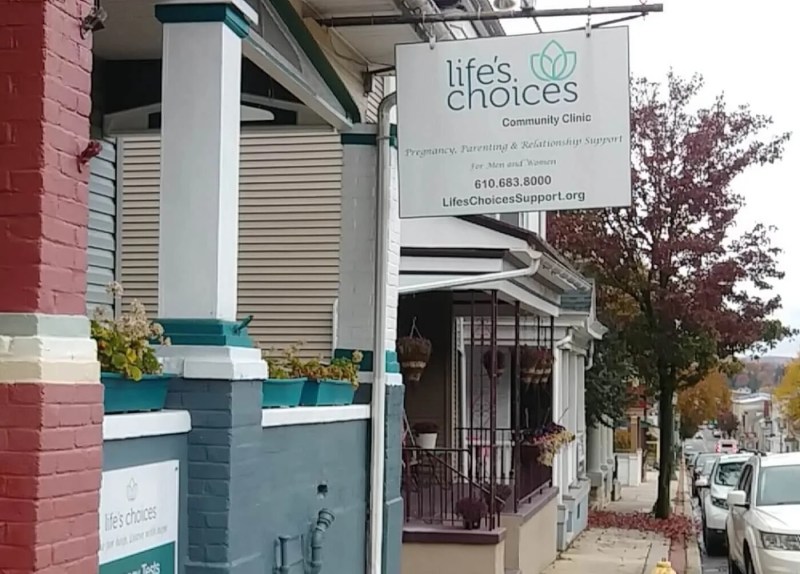
Crisis pregnancy centers advertise themselves as medical facilities that offer free pregnancy tests, ultrasounds, and counseling. In some, staff even wear white lab coats or scrubs. But, in reality, they aren’t real medical facilities and their staff don’t have medical training. Their real mission, Frarey said, is to dissuade women from getting abortion care.
“They are motivated by an anti-choice agenda,” Frarey said. “Their goal is to be misleading. It’s not based in science or evidence-based medicine.”
Nationally, there are over 2,600 crisis pregnancy centers, with more than 150 of those centers located in Pennsylvania. More than 75% of these centers are linked to religious, anti-abortion networks, and about 71% of them admit to using deceptive tactics or spreading misinformation.
Crisis pregnancy centers outnumber licensed abortion providers in Pennsylvania by a ratio of about 9 to 1.
These centers advertise at the top of search results for abortion clinics, promising local abortion assistance. They use misleading names, like “Women’s Choice Network,” and give out medically inaccurate information about women’s health care.
And they compile data that could be used in out-of-state abortion-related prosecutions and litigation.
These centers often locate themselves near actual abortion clinics or medical facilities.
“It’s really easy to stumble upon one,” Frarey said. “They’re positioned so patients accidentally go to the wrong place.”
The harm and who it hurts
Frarey said the harm caused by crisis pregnancy centers is real.
“They are causing tremendous harm to the most vulnerable in our community,” Frarey said. “They target people living in poverty, people of color, young pregnant people—those already facing systemic barriers to health care.”
Pennsylvania’s maternal mortality rate for Black women is more than twice that of white women, and access to reproductive care is shrinking as rural hospitals and clinics face financial strain under Republicans’ “One Big Beautiful Bill.” The law cuts federal Medicaid funding by roughly $1 trillion over the next decade—money many rural hospitals and clinics such as Planned Parenthood rely on to stay open.
“If I had diabetes and went somewhere that wasn’t a real medical facility, people would be outraged,” Frarey said. “But this is happening to women all the time.”
What’s being done?
Pennsylvania’s state government has a history of sending taxpayer dollars to crisis pregnancy centers. But in 2023, Gov. Josh Shapiro effectively cut that funding by not renewing the commonwealth’s contract with Real Alternatives, the Harrisburg-based organization that had distributed state funds to crisis pregnancy centers. Prior to that, from 2012 to 2022, these pseudo clinics received roughly $60 million in state and federal funding.
The state redirected the funding to create a new program for evidence-based and unbiased maternal health support from licensed medical providers.
Now, advocates for reproductive rights are calling for stronger regulations and truth-in-advertising laws to ensure that any organization offering medical services must be licensed and transparent about what it does—and doesn’t—provide.
Meanwhile, Frarey’s patients remain a warning to those seeking abortion care.
“These centers don’t just mislead,” Frarey said. “They exploit fear and vulnerability. And the people who pay the price are the ones who need real care the most.”