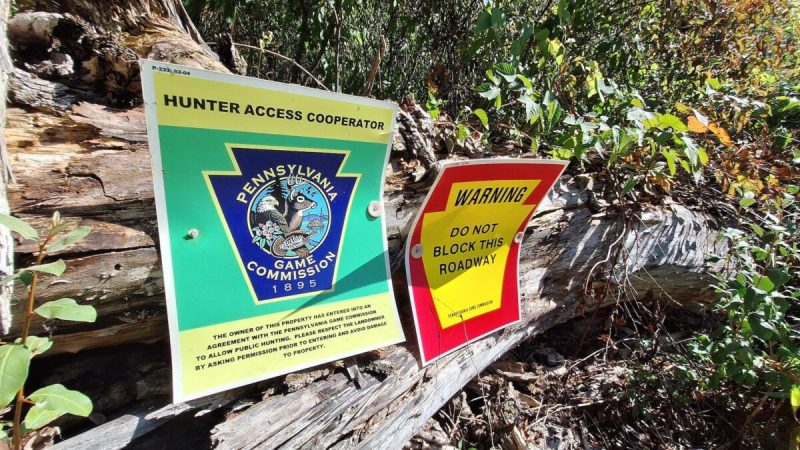
Some Pennsylvania hunters who go to Hunter Access Program properties will have to make an online reservation each time they hunt next year.
John Taucher, private lands section chief for the Pennsylvania Game Commission, spoke at the agency’s Sept. 5 meeting about modernizing the program that dates to 1936.
He said the changes, “That we’re going to be implementing will hopefully bring the Hunter Access Program in to the 21st Century.”
“The Hunter Access Program is our keystone private lands program in Pennsylvania,” he said. “It’s one of the largest, truly voluntary access programs in the country.”
To address complaints the Commission has received from landowners and hunters about boundary lines and what’s permitted to be hunted on private property, a new online portal is being created to map what properties are involved, what restrictions the owner has for hunters, what permissions are required and how to access the properties. “Looking at all of these complaints we got, honestly, most of them revolve the lack of transparency we have with our own system,” Taucher said.
The new maps will reveal the property boundaries and the preferred parking areas for hunters.
Three property tiers for hunters
The agency is looking to create three tiers of properties in the program.
Tier 1 lands are private lands that have open access to hunters and it’s not required to ask permission or make a reservation. “If there’s an open season, they can go hunt it,” he said.
Tier 2 lands will have hunting restrictions and will limit the number of hunters each day through the PGC’s free reservation system. “Basically, the landowner wants to have some kind of hunting restriction or they want to limit the number of hunters on the property,” Taucher said.
Tier 3 properties require the hunters to make reservations that include the landowner’s signature. The number of hunters will be limited through a reservation system. “The hunter has to contact the landowner and get the reservation slip signed to ensure that there was coordination between the hunter and landowner,” he said.
The reservation program will also give hunters categories for the types of hunting including big or small game, waterfowl and trapping. Hunters will be required to obtain a reservation for each day they want to hunt. Junior hunters and mentored hunters are included with the adult hunter’s reservation. Trappers will have reservations for up to a three-week period. “This was determined to allow the trapper to run a trap line, let them set and attract the furbearers they’re after,” he said.
Each property involved in the program will have a map showing the property boundaries and where reservations are required on Tier 1 and 2 lands, it will show how many of the total number of hunter reservations are available for each day. Hunters can only reserve time within a 14-day window of the date they want to hunt. Both the landowners and the hunter receive an email when a reservation is made. Hunters will enter their hunting license number and date of birth when making a reservation.
“The landowner tells us how many people they feel comfortable accessing the property each day,” he said about the reservation system.
The landowner will have access to an online portal where it shows how many hunters have made reservations and can request changes to the Game Commission and make restrictions on the different types of seasons including those for archery, muzzleloaders, shotguns and rifles. “Any kind of restrictions the landowner wants to put on there, they can put on there. We just need to make sure (the restrictions) are explicit, so hunters understand them,” Taucher said.
Commissioner Todd Pride of Chester County asked about the number of properties involved and hunter participation asking, “What was the harvest from last year?”
Taucher responded the agency doesn’t have the ability right now to track hunters who are using these properties. “That’s one of the things I’m excited about with the new system. Specifically, Tier 2 and Tier 3, we will be able to run those numbers and say ‘X numbers of hunters used this system this year.’ We could do that for individual landowners and say ‘Hey, you provided access to 15 hunters. They accessed your property 340 hunter days.’ Currently, we don’t have the ability to run those numbers,” he said.
The agency works with private landowners to allow the public to hunt on their properties. “At its peak, there were over 2.6 million acres enrolled in the program,” he said. Now there are more than 9,500 landowners with about 1.8 million acres involved.
Haley Sankey, vice president of the board from Blair County, asked about landowners needing to use the software. “What are they responsible for as far as population or editing it?” she said. Taucher responded, “It’s completely optional. If they don’t want to do anything, they don’t have to. Basically, all the information that gets put in there is put in by us when we have them sign the agreement,” he said. “If (landowners) want, they can monitor their stuff.”
For the landowners looking at the online portal, he said, “They can be involved in that as they want, or they can just sit back. It doesn’t require them to use the landowner portal,” Taucher said.
Timeline for the changes
The changes to the program are expected to happen with the program starting next summer.
Several aspects of the portal are being tested now through the new Certified Hunter Program that started this year in southwestern Pennsylvania.
Taucher said the computer system is now being tested and the agency is in the process of hiring six limited term staff members to assist with getting co-op properties enrolled.
The new system is expected to be live and operational by July.