A few months ago, a West York Borough Police officer responded to a call at a local retail establishment from a woman who had lost her wallet.
While the officer was speaking to the woman, who appeared to be Latina, someone took a video of the interaction and later posted it on Facebook, claiming that the West York Police Department was engaging in immigration enforcement in conjunction with the feds.
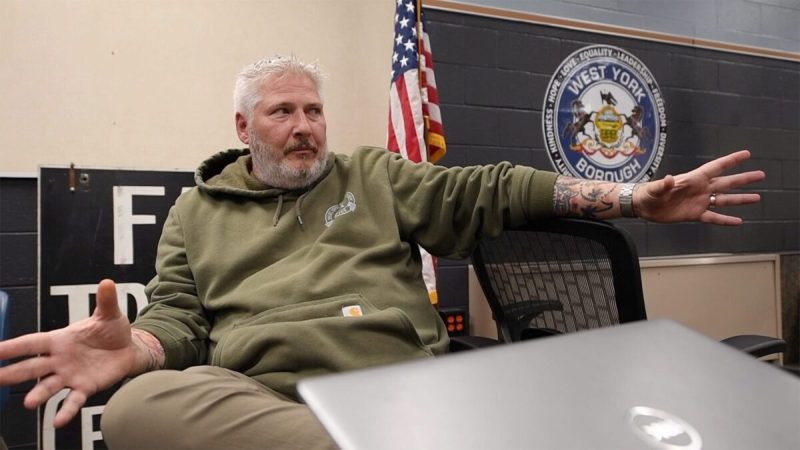
It appeared to West York Police Chief Matt Millsaps that somewhere along the line something became confused. “It was no big deal at the time,” the chief said. “It sounded like a few of these things had gotten mixed up and taken on a life of their own.”
West York has entered into a 287(g) agreement with U.S. Immigration and Customs Enforcement agency to cooperate on immigration enforcement – something the chief said he did to provide his officers with training about the law and the rules so they wouldn’t be caught unawares should ICE call upon the department for assistance – and the department is catching a lot of flak for it, fueled by misinformation and misunderstanding, said Millsaps.
He said the department is not enforcing immigration laws and that ICE has not carried out any large-scale or focused enforcement actions in the borough, a rumor that started, apparently, with the video of the woman interacting with the police officer outside a store. That social media post evolved into some people claiming that West York police officers and ICE agents were outside retail establishments asking people for their papers. It was further fueled by a Facebook posting of a Jan. 21 news story from an on-line media source reporting about the agreement, which was reached in August. That story quickly attracted comments, some critical of the department and some supportive, for agreeing to work with ICE.
The social media posts about West York prompted York Mayor Sandie Walker to release a statement that the city will not participate in a 287(g) agreement with ICE. “When residents fear that interacting with local police could lead to immigration consequences, they stop reporting crimes, they stop cooperating as witnesses, and our entire community becomes less safe. Our focus is on building trust, not creating barriers,” Walker said in the news release.
“There are no ICE stings going on in West York,” the Millsaps said. “We are not involved in some type of big operation, nor have knowledge of such. No West York cops or ICE agents are standing outside retail establishments, or anywhere else for that matter, randomly asking people for citizenship proof. That would be illegal and against the constitutional rights of all.”
Yet, with the current political atmosphere, and the outrage of recent shootings in Minneapolis – ICE agents killing two people in separate incidents and video of the shootings showing something that differs from explanations from the agency and the Trump administration – there has been a focus on ICE operations and fear of its agents.
The topic is “very polarizing,” Millsaps said. He believes the causes of the dissemination of questionable information are multi-faceted.
“In some cases, it may be a selfish motivation to gain attention or clout or just cause chaos on the internet,” he said. “But in other cases, it may be people who genuinely feel like they are helping someone or their cause. …The problem is … they are completely unaware of the circumstances or facts that are unfolding in front of them and can often make the circumstances worse for those they think they’re helping.”
And, he said, “by making broad generalizations based on their limited perspective – seeing an officer talk to a long-time resident who is known to us that turned to us for assistance, just because she looks different than the officer – is precisely the same type of stereotypical bullshit they are accusing everyone else of.”
Millsaps defended the police department’s agreement with ICE – the only department in York County to do so – saying, “If ICE comes into West York, they have to go through our department.”
He hasn’t made any judgments about the shootings in Minneapolis – he would need more information and more investigation to come to a determination about what he said were “questionable shootings” – but he did say the one thing the two shootings had in common is that local police or sheriff deputies weren’t present.
“None of these incidents involved police who are used to being in these situations and are trained to de-escalate the situation, something they do every day of the week,” he said. “It reinforces, in my mind, that if there is some enforcement action, we would want local police (involved). We can serve as a mediator, or a buffer. We’re familiar with the community and the people we’re dealing with.”
Millsaps said he is concerned that new ICE agents – those who have been recruited recently to meet the Trump administration’s goal of detaining 3,000 people a day – don’t have the training to deal with what they may face on the streets. These ICE agents receive 45 days of training, he said, far short of the training police receive at the police academy or through ongoing training while on the job.
“I don’t want to be the poster boy for ICE,” Millsaps said. “I know I put myself in that position. My whole thing is if these guys are going to be doing this (stuff), I want to know. My intention is to have more understanding of the circumstances and, on top of that, have some control over it.”