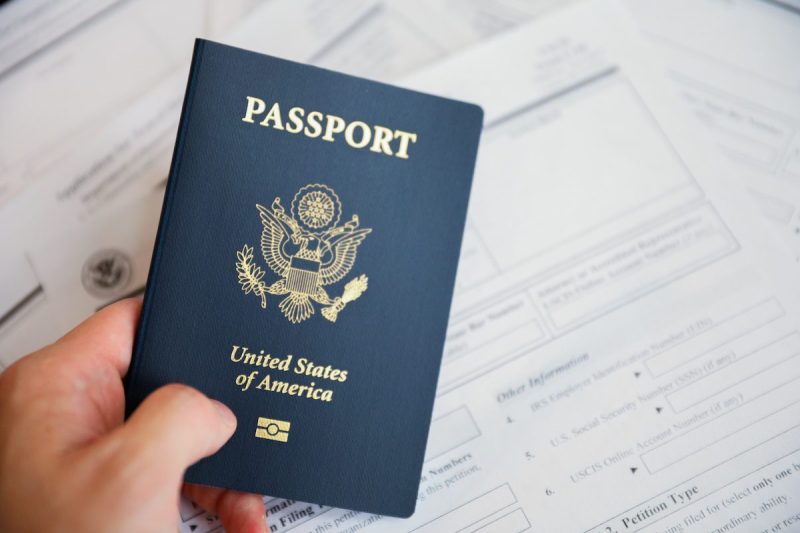
Starting Feb. 13, most Pennsylvania public libraries will no longer be able to process passport applications after a US State Department decision affecting nonprofit agencies.
If you’ve been putting off picking up a passport at the library, you might want to schedule your appointment as soon as possible — before you no longer can.
Starting Feb. 13, nonprofit public libraries will no longer be able to offer passport services. This follows a recent decision from the U.S. Department of State.
The agency determined last fall that existing federal law doesn’t explicitly allow for nongovernmental organizations and 501(c)(3) nonprofits to collect and retain fees related to passport services.
In Pennsylvania, that designation includes the vast majority of the state’s nearly 500 public libraries, according to Christi Buker, executive director of the Pennsylvania Library Association.
In Bucks County, for example, the impacts are limited to the Bensalem library along Hulmeville Road, which now has less than two weeks left as a passport acceptance facility.
The Bensalem branch is the only Bucks County Free Library location that currently offers passport services and has done so for approximately 20 years, said Bucks County Free Library CEO Dana Barber.
The Bensalem library processes approximately 4,600 passport applications annually, she added.
“The stoppage of passport services has an impact on our community members as well as our library staff and budget,” Barber said. “For individuals seeking passport services, most other governmental offices in Bucks County that process passport applications are not open later than 3:00 p.m.; Bensalem branch stays open until 7 p.m. multiple days per week.”
Beyond just potentially inconveniencing residents, many public libraries rely on the revenue generated from passport processing fees.
The stoppage of passport processing in Bensalem is expected to result in a loss of more than $200,000 in annual income for the Bucks County Free Library system, Barber said.
“These passport funds are typically used to offset the costs of providing the service as well as for capital projects like updating HVAC systems, replacing roofs, and repaving parking lots at our libraries,” she said.
How will the passport change impact PA libraries?
Pennsylvania’s lasting legacy as the former home to Ben Franklin, the founder of the first public library in Philadelphia, puts the state in a unique position to be impacted by this change more than most, Buker said.
“In Pennsylvania, only about 15% of our public libraries are actually departments of government,” she said. “In some other states, it is the exact opposite.”
Even if a library receives some financial support from a county or a municipality, they may not officially operate as government entities, she said.
So while this change will go into effect nationwide, she noted that “in Pennsylvania it’s hitting a little bit harder because we have a large percentage of nonprofit libraries versus municipal-entity libraries.”
As in Bucks County, a stoppage in processing passports will result in a drastic cut in revenue that many libraries rely on. The impact of suddenly losing this funding could vary widely across the state depending on how much of library’s operating budget relies on these fees, Buker said.
“For some, it may only be 2% whereas others it could be 20%,” she said.
The stoppage will also mean one less local full-service passport locations — many of which had previously been operating as federally certified passport acceptance sites for decades.
“It’s going to affect our communities in major ways because the other places that accept passports may be further away. They may not be open evening or weekend hours,” Buker said.
For example, in Perry County just north of Harrisburg, the only other place that processes passports is the county courthouse on Tuesdays between 9 a.m. and noon, Buker said.
“So if you need to get a passport in Perry County, you might be driving out of the county to go farther away and to get an appointment its going to be that much harder,” she said.
Some residents may have come to rely on their public libraries as a one-stop-shop to get their passport application completed and submitted correctly. Between just 26 libraries across the state, Buker said, more than 41,000 passports were processed last year alone.
“You might have to wait longer, weeks or months, to get an appointment. You might have to go multiple places to get your pictures done first, and then go to another place to apply,” she said.
“So it’s going to be a lot harder for a lot of our residents to get passports.”
How long will this passport-at-libraries stoppage last?
Ahead of the scheduled stoppage on Feb. 13, federal lawmakers in Pennsylvania have already introduced bipartisan legislation intended to reverse the change for the state’s public libraries.
In early January, U.S. Reps. John Joyce, R-Blair, and Madeleine Dean, D-Montgomery, introduced a bill to amend the Passport Act of June 4, 1920 that would authorize certain public libraries to collect and retain a fee for the execution of a passport application.
Late last week, U.S. Sens. John Fetterman, D-Pennsylvania, and Dave McCormick, R-Pennsylvania, followed suit with identical legislation.
“From Boyertown to Pottstown to Jenkintown, PA-04 depends on libraries for passport applications — and libraries rely on this revenue,” Dean said in a social media post. “When more Americans than ever are seeking passports, it’s nonsensical for the State Department to stop this program.”
Lacey Latch is the development reporter for the Bucks County Courier Times and The Intelligencer. She can be reached at LLatch@usatodayco.com.
This article originally appeared on Bucks County Courier Times: Why the Bensalem library may no longer process passport applications
Reporting by Lacey Latch, Bucks County Courier Times / Bucks County Courier Times
USA TODAY Network via Reuters Connect
READ MORE: More than books: A guide to free services at Pennsylvania public libraries