A federal agency investigating a fatal explosion at a Bristol Township nursing home appears to be focusing on removed portions of the natural gas service line that apparently failed.
The National Transportation Safety Board’s preliminary report released Jan. 28 also confirmed what local emergency responders suspected: A gas leak in the basement was responsible for two explosions Dec. 23 at Bristol Health & Rehab Center along Tower Road.
Three people were killed, 19 were injured, and more than 100 residents and employees were displaced in the blast that prompted a six-hour search-and-rescue operation involving hundreds of first responders.
In a statement, PECO, a company under Exelon, expressed its “most heartfelt sympathies” to the families and friends and “the entire Bristol community affected by this tragic event.” But representatives of the electric and natural gas utility provider declined to answer questions citing a continued participation in the NTSB accident investigation.
Their statement also noted that the private utility company has taken steps to enhance its systems since the explosion.
They include strengthening employee procedures and training, and assessing existing indoor meters — such as the one at the nursing home — and reprioritizing moving them to outdoor locations.
In a statement Saber Healthcare Group Chief of Government Affairs Zachary Shamberg said the preliminary findings indicate the nursing home “acted promptly, while multiple PECO technicians unsuccessfully attempted to repair their gas line.” Saber Healthcare is the management consultant for the nursing home, formerly known as Silver Lake.
The initial NTSB report doesn’t provide a clear answer for what caused a leak on a meter set valve and stated its investigation is continuing.
Generally the federal safety agency doesn’t issue its final investigation findings until a year after the initial incident. But the NTSB probe appears to be focusing on the integrity of the natural gas service line.
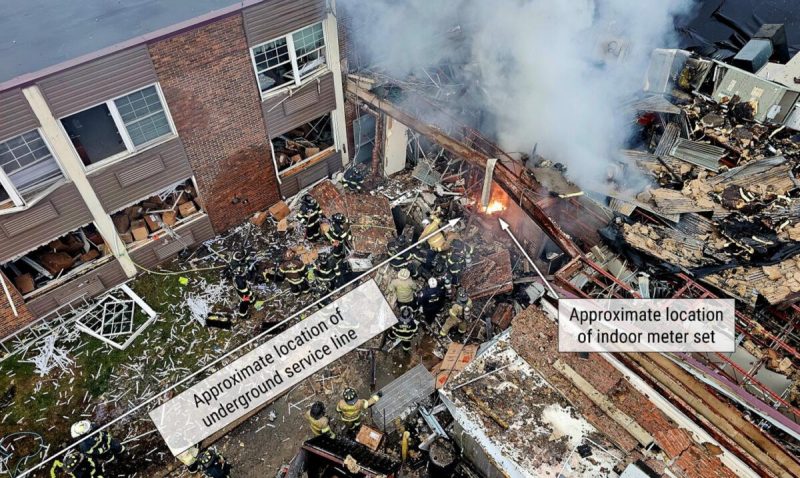
PECO’s parent company, Exelon, provided natural gas to the building through a distribution system that included an underground 1.25-inch-diameter coated steel service line and an indoor rotary meter set located in the basement.
Soil testing performed around the outside of the building approximately three hours after the explosion identified various levels of natural gas in the soil, according to the report.
Investigators recovered the indoor meter set, including piping and fittings that controls pressure to downstream customer piping, and excavated portions of the service line that didn’t hold pressure during testing conducted after the explosion, the report said.
The items were delivered to the NTSB Materials Laboratory for further examination.
This report findings also raise questions about when nursing home administrators reported the gas odor to PECO and when the utility company responded.
A handful of lawsuits filed by victims this month allege that nursing home admins were aware of the complaints from staff and residents about a gas odor at 9 a.m. the day of the explosion; some victims allege that the odor was present for days, and that nursing home admins took no steps to address it.
The NTSB noted that investigators interviewed the nursing home personnel about the natural gas odor in the basement, first and second floors of the building before the explosion. The report, however, didn’t provide a timeline for when those interviewed first smelled it.
This report stated that the nursing home maintenance director reported a natural gas odor in the basement boiler room and a first-floor hallway to PECO shortly after 11 a.m. the day of the explosion.
A gas technician arrived on site at approximately 11:50 a.m. to respond to the odor report, according to the NTSB. An energy technician identified a leak in the basement boiler room and called dispatch to request repair assistance.
Exelon’s foreman directed a meter services technician to perform the repair, and the technician arrived at the building approximately 90 minutes later, less than an hour before the explosion, the report said.
The report noted that the foreman and the meter services technician had less than one year of experience in their current jobs. The union representing the PECO technician confirmed he was among those seriously injured in the explosion.
The building exploded at approxiamtely 2:15 p.m. with about 180 people inside, the majority of them medically frail residents.
First responders reported conducting more than 120 rescues. The blast resulted in a second smaller blast and partial collapse of a first-floor wing into the basement.
Exelon emergency responders arrived at approximately 2:42 p.m. and isolated natural gas flow to the building shortly before 4 p.m.. the report said.
The NTSB report noted that the agency’s future investigative activity, to be part of its final report, will focus on:
- Evaluating physical evidence collected at the scene.
- Reviewing Exelon’s pipeline safety management system.
- Reviewing Exelon’s practices related to personnel training and operator qualifications, task-specific procedures, odor complaint response, documentation, and emergency response.
The condition of the natural gas service line at the building is raised in the most recent explosion-related lawsuit filed earlier this week on behalf of two employees and a visitor who were seriously injured.
The lawsuit alleged that PECO hadn’t replaced the service line to the building with a plastic line “as promised in early 2022.” It also alleges that the utility company didn’t conduct timely line inspections to check for deterioration, splits, holes and fractures.
PECO announced in 2022 that it was investing $6 billion to “inspect, do corrective maintenance and invest in new equipment because it knew gas lines were unsafe and outdated,” according to the lawsuit.
In a press release at the time, the company stated it was accelerating efforts to replace existing natural gas main and service lines with new plastic pipe, and that it was “on track” to complete the replacement of all cast iron and bare steel service lines by the end of 2022. All cast iron and bare steel natural gas mains were to be replaced by 2035.
The lawsuits filed since the explosion also have alleged that PECO and Saber Healthcare Group failed to evacuate the building after residents and staff reported a strong gas odor. The NTSB report didn’t address whether evacuations should have occurred.
Other allegations were that employees and residents continued to take smoke breaks despite the gas odor, that PECO didn’t shut off gas service while working on the suspected leak and that the utility company didn’t send a crew for three hours after the nursing home reported the gas odor.
Pennsylvania Department of Health inspection records show the center long struggled to meet the state standards for licensed skilled long-term care providers under its previous ownership.
The Centers for Medicare & Medicaid Services reported 200 complaints in the past three years at the facility that resulted in a violation and four times a resident was either harmed or in danger of being harmed. Last year the federal government fined the operators more than $400,000.
Since taking over the Bristol Health & Rehab Center on Dec. 1, Saber HealthCare Group has said it was working with the state to correct “longstanding issues” within the facility.