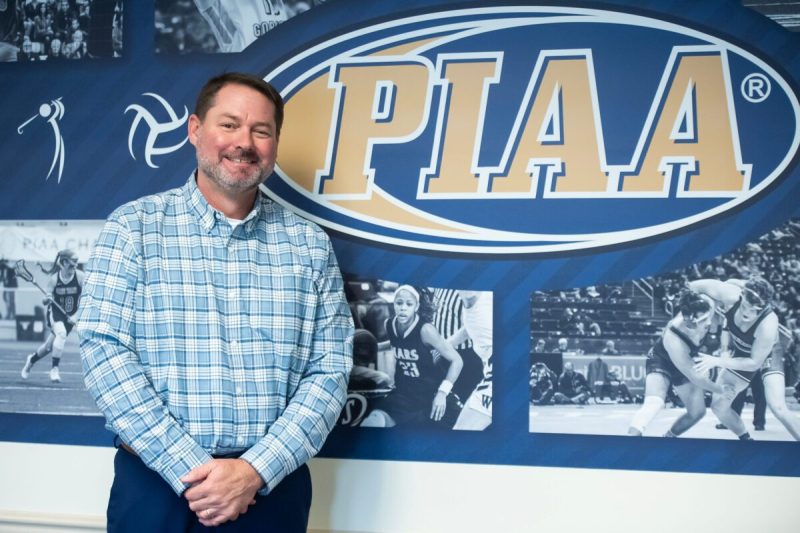
Mark Byers grew up in the shadow of the PIAA.
His older sister was an athlete at Carlisle High School, and so was he. But it was their father, Ralph, who brought the PIAA home. Ralph was a coach and hall of fame wrestling official for more than 27 years.
Mark Byers, who became the PIAA executive director on Jan. 1, knew the organization through the state wrestling championships.
“The funny part about the PIAA is the vast majority of kids never come in contact with the championship event,” Byers said in a December interview with the York Daily Record. “It usually ends at the district level. There were a couple of times I got to tag along and sit in the stands and listen to people yell at [officials].”
Byers became the organization’s ninth executive director since its inception in 1913. He follows Bob Lombardi, who retired at the end of 2025. Byers, a graduate of Carlisle High School and East Stroudsburg University, has been with the PIAA since 1999.
He sat down with us before assuming his new duties, answering every question we threw at him. Here are his answers.
Was this always the dream job for you?
This was by chance, but I think it’s turned into my dream job. I was in grad school for sport administration and we had a distinguished alum, who happened to be Bob Lombardi, come up and speak. He was the associate executive director at the time, and said ‘if this is something you have interest in, why don’t you volunteer?’ I called the office after he spoke, and I interned at the 1999 wrestling championships. That was really my first PIAA event.
How will this position differ from what you were doing?
I think the biggest change is not being involved in the day-to-day scheduling and planning of our championship events. We have a tremendous staff, and they’re going to fill in that void as I move into the new position. The day-to-day conversations I have with the people running those events out at the district level, that’s going to change a bit and probably be what I miss the most. Because over 26 years I’ve formed a lot of different relationships and good friendships. Not that those friendships go away, but the daily interaction is gonna change significantly.
What are you looking forward to the most?
What I foresee is a little return to understanding the value of what interscholastic athletics is. I never played in state championship, never even made the state tournament. But the importance of getting your first varsity uniform, those are the things that stick out to me. Running into the gym, and that time the Carlisle Intermediate School, with the wrestling circle. I grew up living it, understanding that our coaches, our athletic directors, our principals, play a huge role in impacting student athletes’ lives. Not just at championship events, which culminate with the last teams’ playing, but every single day in practice, every single competition. That’s the major role in where we’re impacting the largest number of student athletes.
What are you least looking forward to?
Losing some of those relationships. And I haven’t been involved in a lot of the legal side of things here, when individuals decide for eligibility reasons, they need to take PIAA to court. Defending ourselves, we think that our rules are done in a systematic process where our membership is aware the board puts them through a three-reading protocol. They’re educators that comprise the board, and we feel they’re sound. When individuals challenge that, we will be there to defend ourselves.
How will the PIAA look different with you as the executive director?
I have hair, that’s one. We’ve gotten young in a hurry. I was the young pup at 24 when I started in ‘99, and we’ve seen progression as our staff has been brought on. The last couple of years we’ve hired tremendous individuals. I went from being what I thought was the youngest and tech savviest on the staff to the furthest thing from that now. I’m looking forward to seeing their growth. Bob and I share a background in hospitality management. His family owned a hotel on a small lake in northeastern Pennsylvania, and they ran a restaurant there. My background, I worked in restaurants. I think everybody should work in a restaurant at some time, just to know how to treat people, how to deal with people and provide customer service. I hope that’s what individuals get when they contact this office.
What was the No. 1 question you have been asked since news broke that you are the new executive director?
What are you gonna change? I think that’s a misunderstanding of the organization. You know, we’re made up of hundreds, if not thousands, of individuals that comprise our steering committees, comprise our district committees and ultimately comprise the board. It’s not a one-person show here. But it’s making sure that the actions and the movement going forward represent our membership. I think people forget about the other side of our business, which is the officials, and making sure we continue to have the best officials program in the country. I think we have that. Sometimes it gets lost in the conversation that we’re just about playing games, but those games don’t exist without the officials.
There are officials shortages in every sport. What is the PIAA doing to try and change that, and what happens if it doesn’t?
If it doesn’t happen, kids don’t play. But we’ve been successful. We’re at our largest group of registered officials in the history of the organization. We’ve grown to more that 15,000 individuals across the state, and it’s a by-product of schools making opportunities available for kids to play. The greatest growth we’ve seen is at the junior high/middle school level. And the difficulty is those programs expanding is filling the void with registered officials to make sure those games can take place. It’s tough to get people to games at 3:45 or 4 p.m. So, it’s a special person who makes themselves available for that time, especially at that level.
How does the PIAA go about making the officiating as consistent as possible from one county, one league to the next?
I’m not certain that the general public is aware of our setup with officiating and how we try to have a consistent statewide application. We have statewide interpreters for each of the sports under our jurisdiction. Those interpreters are hired by the office, and they really are an extension of our staff. In turn, they become the rules experts. They are in direct communication with each of the district interpreters and also the chapter interpreters that exist across the state. We have somewhere in the neighborhood of 450 chapters of officials across all of our different sports. We try to have a hub and spoke system, where the office with the statewide interpreter serves as the headquarters, and then we branch out. So the same message that’s being sent from the office or statewide interpreter is ultimately heard at the local level by every official, and in our preseason rules meetings, by every coach in the state. We aren’t going to change individual judgment of the official. We have to make sure the message is the same from the top of the organization to the rank and file.
What is the biggest change you’ve seen in your time at the PIAA, not just in the organization, but in the landscape of high school athletics?
The thought process out there that every kid is going to play in college and is going to become a professional athlete. That didn’t exist years ago. The mindset that an 8-year-old should be playing in a national tournament is the biggest change in the landscape. It’s no longer OK just to play in your community with your friends and develop your skills and work your way up. There’s sports specialization that’s taking place. And that’s difficult because kids need to understand there is transfer skills that can relate to the sport of interest by participation in another sport. I think the one that always hit home with me, I never played football. I was a kicker, so that doesn’t count. But there was a time where your football players, your skilled players, became all your runners, and your line became your throwers in track and field. And the transfer abilities that can come from throwing discus or throwing shot to how they’re playing on the football field, make them better athletes.
What’s your biggest challenge in the next five years, 10 years?
I hope they’ll have me in five years. I hope they’ll have me in 10 years. That’s probably the biggest challenge. Making sure I’m going the job that the board intends and the membership intends. I think the ever-changing landscape of media makes this difficult. Everyone has become a reporter. Everyone wants access. We know that impedes your ability to work. The advent of video coming out of COVID, where everybody, again, has become a member of the media and thinks it’s their right to be able to come into schools and stream those events. That’s what has become difficult. Five, six years ago, I wouldn’t have anticipated this. So you also don’t know what you don’t know.
A big question, especially around the championships, is will there be a separation of boundary vs. nonboundary schools?
I think the legislature will lead us in that direction if there’s a desire to go in that direction. I think the No. 1 misconception is the PIAA has the ability, with a magic wand, just to wave it and make it happen. Action in 1972 required the PIAA to admit private schools into our membership. The only thing I ask, if there is desire to move in that direction, that protections be afforded the PIAA. It’s easy to say we can do it and pass the legislation, but if every action that we take results in litigation, then we’re just throwing good money after bad. We hate to see that we’d be adversarial toward our own membership, and vice versa.
Is it easier for kids to go from one public school to another public school?
It really depends on the public school. There’s still a requirement, in most instances, that they establish residency. But we do have public schools that also accept tuition students. So, if they accept tuition students, those that aren’t residents of their school, that transfer can take place. I think what has changed the most is we’re just a much more transient society, people change jobs within a three-year period. I’m a dinosaur being here 26 years. That just doesn’t happen anymore. They’re willing to change jobs, change locations. It’s not even that they’re moving far. They’re moving six miles down the road and going to a different school district. That means the parents have to be willing to do that as well.
Does the transfer portal in the NCAA concern you for any “trickle-down” potential?
We get the trickle-down effect for almost everything that happens at the collegiate level because that’s what’s on the national sports broadcasts. I think if you ask an individual walking down the street, they think we’re the NCAA of Pennsylvania with a huge building and 500 employees. We have 15 full-time employees and hundreds, if not thousands, of volunteers. But we do have that trickle down, why don’t we have this college rule or why don’t we do that? We have rules that are specific to the interscholastic setting, and there are reasons for that. But the transfer portal and the prominence of student athletes moving from one school to the next, really without penalty, occupies the public mind.
Girls wrestling and flag football are growing. What’s next?
I’m not advocating for it, but just knowing what’s out there, there’s a large contingent of schools participating in ice hockey. To this point, our schools and our membership have said they like the sport sitting where it is. It’s difficult for schools to make the choice to practice at 9 or 10 p.m. So having that in a club setting offers some protections. It’s also a very expensive sport. The other sport that is gaining prominence is rugby. You see it on the international level, especially with sevens. It’s an opportunity for a smaller team to exist. There’s not a whole lot of equipment.
Has the Name Image Likeness (NIL) changed the landscape of what you’re doing?
The sky has not fallen is the best way I can reply to that. What exists in the NIL at the college level hasn’t transferred to the high school level. The vast majority [of high school athletes] serve as brand ambassadors. A company have kids sign up for free if they are willing to mention the company on all of their social media accounts. They get product or discounts on the product, but no cash is exchanged.
Several years ago, you were asked in an interview what the PIAA meant to you, to define it. You said it was community. That might not be the case anymore. How do you get back to that feeling of community?
I think that goes to the customer service side of things. We need to do a better job of providing our message as opposed to waiting for the media to write that message for us. I would also encourage the general fan, the student-athletes, the next time they are at a contest to realize there’s no reason why that school needed to open. Because they’re hosting a game that involves no one from their community. No one they’re affiliated with. But there are individuals who love high school sports. They have great facilities. They open them up, they take less money than they’re worth, in order to make sure the kids have a place to play. Pennsylvania’s made up of extraordinary people who open their facilities in order to allow kids to play. And that’s really, ultimately, the community I was talking about.
What do you think your dad would say to you as you start this new job?
I think the world of him, and I think he would be proud. He’d probably figure out the things that he thinks I’m screwing up and tell me about it. There was not getting past his willingness to tell you where he thought you stood. He loved the organization. His favorite thing before his passing was working as a weigh master at our wrestling championships for both team and individual. He and others who retired as championships officials but wanted to run our weigh-ins to make sure they were done properly. It was also the camaraderie. That’s what I miss the most with him not being around, is being able to share that with him. When I first started, I was Ralph Byers’ son. By the time we got near the end, and I had more of a role in the organization, he was Mark’s dad. It was a neat transition to be able to go through that with him.