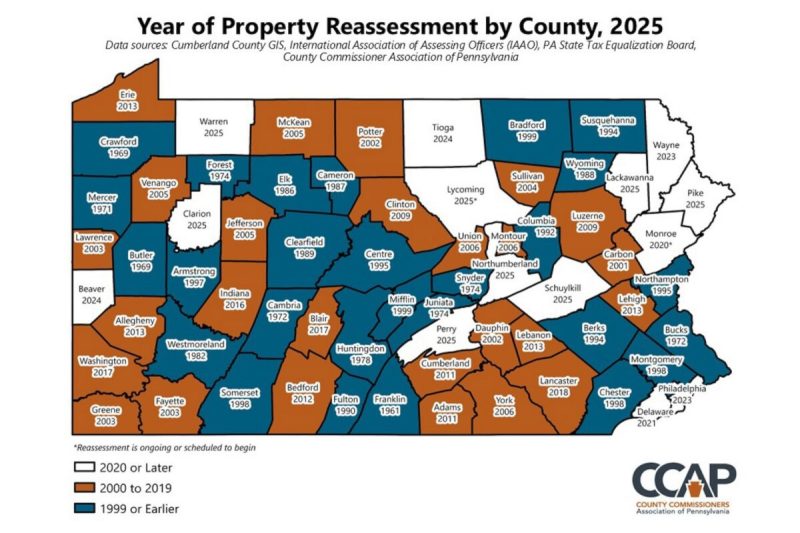
More than a third of Pennsylvania’s 67 counties have not performed a full property reassessment since 2000, leaving around 40% of the state with antiquated data used to tax it.
The 27 counties reassessed in 1999 or earlier cover Philadelphia’s collar, some urban areas and vastly rural spaces all around the state. Another 26 counties were reassessed between 2000 and 2019.
Fourteen counties have been reassessed since 2020 or are in the process. Wayne County’s reassessed values went into effect in 2023. A year later, Beaver County finalized its reassessed property values. Others, like Pike County, are undergoing the process that balances a county’s tax base.
Other counties are fine passing the time. York County has not held a reassessment since 2006 and commissioners there have no desire for doing something that cost Beaver County almost $8 million, Schuylkill County more than $7 million and Lackawanna County nearly $6 million to do.
Pennsylvania is the only state in the country that does not require countywide reassessments every few years.
Some counties have not had a full property reassessment in decades. Franklin County, on Pennsylvania’s southern border with Maryland, last did one in 1961.
Franklin and 26 other counties are recouping tax revenue based on assessment data that pre-dates the 2000 dotcom bubble, 2008 housing crash and 2020 COVID-19 pandemic.
Outdated assessments over time imbalance tax bases, requiring a portion of real estate owners to shoulder a heavier burden to cover the municipal, school and county taxes that others paying at substantial discounts.
A lot has happened to the real estate market since 1999. It creates a taxing inequality where municipalities and school districts within a county are not getting the type of taxes they should, said David Dean, president of the Pennsylvania Association of Realtors.
“Certain people who purchase property more recently may bear a heavier burden, tax-wise, than those people who have lived in their house 30, 40 or 50-plus years,” Dean said.
A misconception about countywide reassessments is that they are done to increase tax revenue for local governments.
By law, a reassessment has to be revenue neutral, said Kyle Kopko, executive director of the County Commissioners Association of Pennsylvania.
“We don’t want to be in a situation where property values have changed over time ― they could go up, they could go down,” Kopko said. “We want to make sure that is fairly and accurately documented for taxation purposes.”
If commissioned properly, an industry benchmark is that after a countywide overhaul, about a third of property owners would see taxes go down, a third would see an increase and a third would see little to no change.
That is because some have been paying too much and others have been getting a discount, in some cases for decades.
The Realtors association has advocated for requiring Pennsylvania counties to conduct reassessments more frequently, ideally every four to six years.
CCAP’s latest literature details broader-range ideas, such as dedicated state funding for counties to support reassessment efforts, modernizing data collection and designating a state agency to oversee funding and develop statewide standards.
In Maryland, reassessments are done every three years rotationally, where a third of a county’s properties are reassessed each year. In New Jersey, properties get reassessed every time improvements are made.
While frequent assessment changes can fluctuate a property’s tax liability, staying current keeps the changes from spiking and establishes some predictability within a market sensitive to the intertwining of assessed, appraised and fair market real estate values.
Assessed value applies to taxation, appraised value is a certified estimate of a home’s worth and fair market value is whatever someone is willing to pay for it.
Home prices can take a hit when those three numbers grow too far out of sync for a property, said Joel Berner, economist for the real estate site realtor.com.
Disruptions to the realty market, like the dotcom bubble, housing recession and pandemic, can heavily disrupt the values. That those three financial watershed moments happened in a 20-year period underscores how imbalanced property assessments have grown in many of Pennsylvania’s 67 counties.
A home with an outdated assessed value, Berner said, would have a low tax bill artificially inflating the value of the home.
That lower tax bill could attract a buyer, but any increased value could change since the next reassessment would raise the taxes. And a sale could trigger a spot assessment.
“If your property tax bill goes up, a buyer looking might say, ‘I can’t afford it at this price since it’s more in taxes,’” Berner said. “You might see lower bids on homes.”
This distorts housing sales and prices and even affects housing stock since someone getting a steal on decades-old property taxes might be more inclined to stay in their home.
“Buyers don’t like uncertainty; markets don’t like uncertainty,” Berner said. “The disjointed way in which these assessments are done in Pennsylvania is adding some unnecessary friction to the market, and some unnecessary uncertainty to the market.”