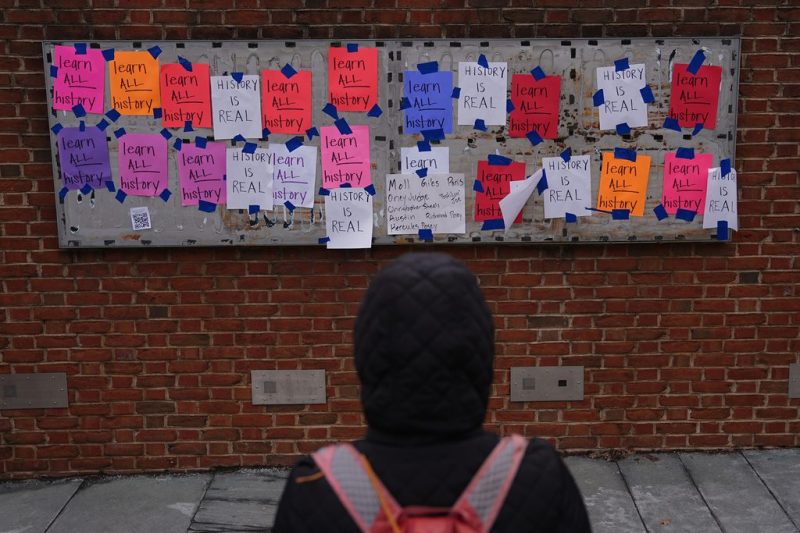
Gov. Josh Shapiro joined the city of Philadelphia in a lawsuit Tuesday challenging the Trump administration’s removal of an exhibit recognizing President George Washington’s history with slavery from Independence National Historical Park.
The National Park Service last week removed interpretive signage at the former site of the president’s house on Independence Mall, where visitors flock to see Independence Hall and the Liberty Bell. The exhibit included historical details of the nine people enslaved in the house where Washington and First Lady Martha Washington lived.
Mayor Cherelle Parker’s administration sued Interior Secretary Doug Burgum and the U.S. Department of the Interior on Thursday, claiming the exhibit and others in the park are covered by an agreement between the city and National Park Service that requires advance notice of changes to exhibits.
In an amicus brief filed in U.S. District Court for the Eastern District of Pennsylvania, Shapiro notes his administration has a strong interest in ensuring historical monuments in Pennsylvania present an accurate portrayal of the commonwealth’s history. That’s especially important given the approach of the 250th anniversary of the signing of the Declaration of Independence this summer.
The brief also says Shapiro has a compelling interest in protecting the role of state and local governments from “the abuses of federal executive power typified by the conduct at issue in this case.”
“Donald Trump will take any opportunity to rewrite and whitewash our history — but he picked the wrong city and the wrong Commonwealth,” Shapiro said. “In Pennsylvania, we learn from our history, even when it’s painful. We don’t erase it or pretend it didn’t happen.”
The brief notes the history of slavery in Pennsylvania is recorded at numerous other historic attractions across the state, including more than 70 historic markers maintained by the Pennsylvania Museum and Historical Commission.
“Those displays aren’t just signs — they represent our shared history, and if we want to move forward as a nation, we have to be willing to tell the full story of where we came from,” Shapiro said in a statement announcing the filing Tuesday.
The exhibit was created more than 20 years ago as the result of “a concerted, community-led effort to ensure that the history displayed at Independence Mall is complete and faithfully told — the good and the bad,” the brief says.
The Pennsylvania House of Representatives had a role in its beginnings after lawmakers passed a resolution in 2002 urging the park service to tell the stories of the people enslaved by Washington and to place a permanent plaque at the site.
State Reps. Jared Solomon and Ben Waxman, both Philadelphia Democrats, and City Councilmember Rue Landau released a statement noting Tuesday was World Holocaust Memorial Day and warning of the consequences of erasing history. Survivors have endured movements over the decades by people in power to question and discredit their first-hand accounts of the Holocaust. Others have tried to glorify Nazi leaders.
“That is how we felt — and we can only imagine how the Black community felt,” they said of the memorial’s removal.
“This year, America celebrates its 250th birthday. It’s time to confront our past, engage with our present, and chart a new course for our future. The American story cannot be told without the Black experience — each shapes and informs the other in an ongoing dialogue about what it truly means to be American,” the statement said.
In the brief, Shapiro asserts the Trump administration is “whitewashing history,” by dismantling the exhibit. It notes President Donald Trump signed an executive order in March directing the Interior Department to scrub monuments of “descriptions, depictions, or other content that inappropriately disparage Americans past or living (including persons living in colonial times).”
Instead, the order directed, monuments should focus on Americans’ greatest accomplishments and the nation’s natural beauty. Shapiro’s brief argues that is at odds with the Trump administration’s re-installation of monuments to southern military leaders from the Civil War.
“Without judicial intervention, the federal government will be permitted to selectively bury aspects of history that address slavery while celebrating individuals who fought to preserve slavery, all under the arbitrary implementation of the same rationale,” the brief says.