The day that Joy Wheeler lost everything, but her life, was a Tuesday.
In a nursing home Tuesdays are not much different than Wednesdays or Sundays, something Wheeler, 59, has learned over the last five years. The routine of each day remains the same as the last.
On that Tuesday, two days before Christmas, Wheeler, who is crippled by neuropathy in her legs, wheeled herself to the first-floor activity room of the Bristol Health & Rehab Center.
After eating lunch, she returned to her second-floor room. She climbed into bed and started scrolling on her cellphone.
In an instant, the world came crashing down around her and more than 100 others inside the Tower Road building on Dec. 23, 2025.
“I said to my roommate, ‘What the hell was that?’ I thought I was dreaming,” Wheeler said recently. “Then I got into my wheelchair, and I can’t get out of this room.”
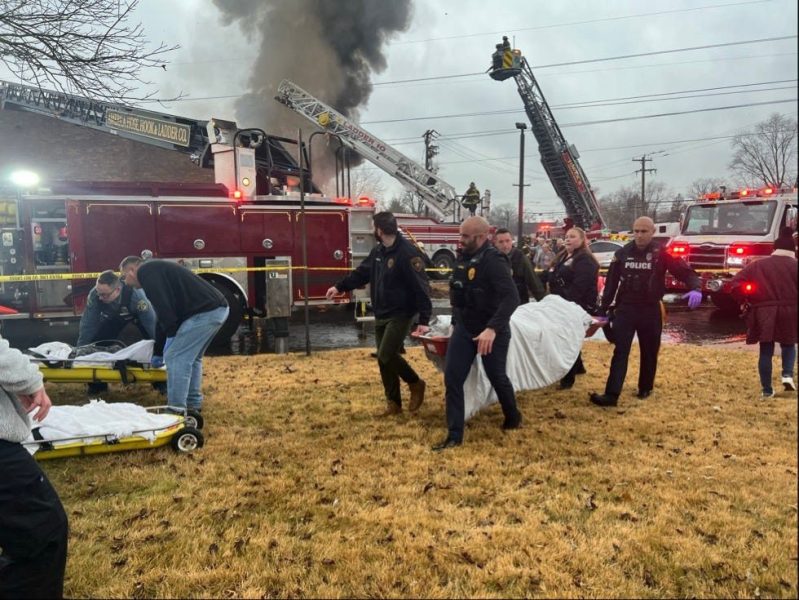
Before that cold Tuesday ended two people would be dead; a third died 13 days later. Another 19 were injured including Wheeler. Residents and employees were displaced, ripped from the familiar and thrust into the unknown by an explosion that would rock the neighborhood between Bath Road and Veterans Highway, just feet from Lower Bucks Hospital.
The National Transportation Safety Board is leading the accident investigation and is expected to release its preliminary findings this month, a spokesman confirmed Jan. 20.
PECO and the nursing home immediately confirmed that a suspected natural gas leak in the basement was being worked on before the explosion.
Four weeks later, a black mesh-covered fence guards the perimeter of what is left of the two-story building, known in the community by its former name, Silver Lake Nursing Home.
A single Christmas decoration peeks through one of the last intact windows and a tilted picture frame is seen through another. Plywood hides the holes of the other missing windows.
Parts of the buckled brown brick facade look like a Jenga tower on the verge of toppling. Empty wheelchairs and patient beds wait among the debris piles behind the fence.
In neon orange paint the word “OK,” with an arrow pointed toward the Lower Bucks Hospital campus appears to signal where the building sustained the least damage.
Other signs of the chaos that Tuesday are scattered throughout the property.
Half-filled cases of water sit as if just placed there. Purple latex gloves and yellow “CAUTION” tape lay in the mud and grass.
Memorials of artificial flowers are planted at the nursing home sign at the corner of Fayette Drive and King Street. More flowers and a gold crucifix are fixed on the fence.
Glass shards fill thin asphalt cracks in the driveway like shiny rivers of tears.
Vehicles slow as they approach the collapsed wing above the basement where the natural gas lines are located. Some stop for a few minutes to take in the devastation.
The depth of the terror and bravery on that day and every one since is still being absorbed by those who lived it. The accounting of what was lost is still being calculated.
“I feel totally abandoned — totally forgotten,” Wheeler said recently. “I just feel totally alone like I have no one. I’m in a box and I can’t get out.”
Fire chief talks about a rescue effort like none he experience before
The Third District Volunteer Fire Co. station sits less than a mile away from the 174-bed nursing home.
Weeks after the fatal blast, Chief Howard McGoldrick is still learning about the heroic acts of not only the hundreds of firefighters and police who converged on the property that day, but employees and bystanders.
Residents of Winder Village, the neighborhood next to the nursing home, ran out of their warm homes with blankets and coats for those rescued, some wearing only in thin cotton house coats.
He’d also love to know the name of the plumbing company whose passing van stopped and its workers jumped out to help rescuers carry victims to safety.
And the chief thinks often of the nursing home maintenance man, injured in the blast, who signed himself out of the hospital and walked back to the scene to help bring people out.
There were upwards of 50 window rescues, many on the second floor, a number that McCormick called astronomical.
Window rescues are high risk efforts, he said. In his 36 years as a volunteer firefighter McGoldrick said he has only taken three people out of buildings through the window.
By his count, an estimated 119 residents and eight employees required assistance to get out of the building, McCormick said. Other employees were blown out through windows on the first floor.
Responding Bristol Township police officers carried residents unable to walk over their shoulders. One unidentified officer carried people two at a time.
The officers who participated in the rescues declined to be interviewed. Police Chief C.J. Winik said they told him they were just doing their job.
Bristol Health & Rehab employee buried alive requests prayers for survivors
Certified nursing assistant Natalie Olive opened her eyes and saw darkness that Tuesday.
Dirt and dust clogged her ears and nose. She could taste it in her mouth and feel it in her hair. Her clothes felt soaking wet.
She was buried alive with a coworker beneath who knows how much concrete, metal and glass.
“All I remember is when I saw a light, I grabbed my coworker and said, ‘We have to get out,’” Olive said.
Weeks later, what Olive remembers about her 7 a.m. to 3 p.m. shift is it was colder than usual inside the building. There was also a strange gas smell.
The smell was so strong that around 1:30 pm Olive went outside for a walk to get some fresh air. She still had 15 minutes left before she had to return to work so she went to the first-floor break room to use her cellphone.
There was a boom immediately followed by the walls around them and the ceiling above collapsing.
“It just happened out of nowhere.”
Olive and the coworker managed to push themselves out of the debris and climb out of the wall into the parking lot. Once outside, all around her Olive saw coworkers lying on the ground bleeding, she said.
“We were just cold, wet and waiting for help,” said Olive, her voice choking with emotion.
She spent Christmas Eve and Christmas day in the hospital. She lost her cellphone, bank card, and identification. And she lost her job.
Perhaps worst of all, she simply feels lost.
“Everybody keep praying for us please,” she said. “Hopefully it never happens anywhere else again.”
80 miles away, a Bristol Health & Rehab Center resident feels like a prisoner
Robert Flesch remembers the sound and feel of that Tuesday — it was like a garbage truck ramming into the wall. Then the room caved in.
“Your whole body was concussed. It was like a giant concussion,” Flesch, 64, said. “It scared the hell out of me.”
Flesch didn’t know what happened. He had suspicions.
Hours earlier, a maintenance guy came to his door, he said. Flesch had to go to a common area down the hall. There was a gas leak in the building, the man said. But PECO was working on it.
The gas smell hit Flesch when he entered the hallway. The smell followed him into the common room where about 50 other residents sat watching TV.
“There is a gas leak here. We should all be evacuated,” Flesch said he told other residents in the room.
But nothing happened until around 1:30 p.m., he said. That is when the maintenance guy returned and told them they could go back to their rooms.
The gas smell was still really strong, Flesch said. Strong enough he mentioned it to the maintenance guy.
“It’s just the residual,” the man said. “PECO told me it was fixed.”
Three minutes later, Flesch was struck with chunks of concrete and glass. Dust smothered him. He lost hearing in one ear. His wheelchair was surrounded debris two-feet deep.
“My room was decimated,” he said. “God had me in a bear hug. If I was one inch to the left or one or to the right, I’d have been gone.”
He heard a familiar voice in the hallway asking if anyone was inside.
An assistant psychiatrist helped Flesch navigate his wheelchair through the rubble, then out a side door.
Once Flesch was outside, the man went back in the building to rescue others. He went door-to-door on the whole floor, Flesch said.
“He got a lot of people out,” he added.
Flesch waited in the damp, freezing winter cold with other victims on someone’s front lawn. About 90 minutes later, he and the others were wheeled over to the nearby Lower Bucks Hospital, he said.
From there, he and two other residents were taken to a nursing home 83 miles away in Northampton County with nothing but a blanket he had grabbed off his bed, he said.
Everything else he owned is most likely buried including two prosthetic legs that cost $174,000 and $1,000 orthopedic shoes, he said.
At the new nursing home the staff collected old clothes he could wear. His brother recently made the 90-minute drive to bring him a few new outfits, he said.
Flesch said he reached out to the Bristol Health & Rehab Center administrator asking what was going on with his personal belongings. A company will retrieve and restore what is salvageable and return it to him, he was told.
“How long will that be?” Flesch asked. “I told her I want my legs.”
She didn’t have an answer, he said.
Without his prosthetics, Flesch can’t get physical therapy, he said. He still can’t hear out of his left ear either.
Before the explosion, Flesch said he was making arrangements to leave the nursing home and move into a South Philadelphia apartment in January.
But when he contacted the Social Security office in Bucks County about transferring his monthly check to him instead of the nursing home, he was told that he’d have to come in person to make the change.
When he told the clerk that he was in a nursing home more than 80 miles away with no way to get to the Fairless Hills office, he was told there was nothing they could do.
He is starting to feel like a prisoner with no parole date, Flesch said.
“They brought us out here and forgot about us,” Flesch said. “I don’t like being forgotten.”
Remembering those lost at Bristol Health & Rehab Center
Muthoni Nduthu had less than an hour left on her 7 a.m. to 3 p.m. nursing shift before her Christmas break started.
The spiced chicken she prepared for the family dinner the day before was marinading in the refrigerator. She also made a batch of her famous mandazi, a deep fried dough snack popular in her Kenya homeland.
The next day, Christmas Eve, Nduthu, 52, her husband, three sons and granddaughter would leave for North Carolina to visit her brother for the holiday.
Family always came first to the Bristol Township woman, those who knew her said. And everyone in her life, it seems, was like family.
On Dec. 23, around 2:14 p.m. Nduthu was standing beside a coworker on the first-floor of Bristol Health & Rehab Center when it crashed into the basement.
Her coworker was rescued but severely injured including brain trauma and a broken leg that twisted her foot backwards, according to one of a handful of lawsuits filed so far. She survived. Nduthu would be claimed in the blast and collapse
Firefighters recovered Nduthu’s body from underneath the debris six hours later. She was the only nursing home employee killed in the explosion. Her cause and manner of death has not yet been released.
Her Jan. 17 funeral service drew hundreds of mourners to St. Ephrem Catholic Church in Bensalem. They included her parents, who flew in from Kenya, 12 siblings, coworkers and two nurse honor guards.
In a dozen tributes Nduthu was remembered with words like kind, generous, dedicated, funny, joyful, strong, compassionate, and as a “great, great, GREAT chef.”
Husband David Ndegwa Mathenge wrote in his eulogy how they met in 1992 in Mombasa, a coastal city in Kenya and married two years later. In 2004 the family moved to the United States.
Nduthu became a U.S. citizen. She worked her way up from certified nursing assistant to registered nurse guided by a passion for helping others, Mathenge wrote.
“Her legacy lives on in our sons, in the friendships she nurtured, and in the strong foundation of family she built,” he added.
Her youngest son, Kaumu “K.K.” Ndegwa, a senior at Harry S Truman High School, called his mother “truly my best friend in the whole world.”
“The day my mom slept her permanent sleep a piece of me was lost,” he wrote. “No matter who I hug now, I know I will never feel anything quite like a hug from my mom.”
Far less is known about the lives of the two female residents who died at hospitals after the explosion. The name of only one has been released.
Patricia Ann Mero, 66, died Jan. 5 at St. Mary Medical Center. Her cause of death was blunt force chest trauma, according to the Bucks County Coroner’s Office. Her two sentence obituary included no information about family and listed her services as private.
But former Bristol Health & Rehab Center employees left their memories of Mero under her online obituary.
“I will always remember Pat coming in the beauty shop every Wednesday to have her hair done and she loved the chocolate candies I always had,” wrote Ellie Taylor in an online message.
Colleen McCarthy called Mero an “amazing soul.”
“I loved her enthusiasm and spirit during our activities and especially the music programs we had,” McCarthy wrote. “Her light would shine then for sure. Singing and dancing along.”
Bristol Health & Rehab Center resident rescued from second floor: ‘I thought I was going to die right there’
Joy Wheeler has trouble remembering where she is.
“I stare at the ceiling and say, ‘This is Silver Lake. I’m not anywhere else, ‘” she said. “I just can’t comprehend I’m not in there anymore.”
But the memories of that Tuesday play as if on a loop in her mind.
The room shook as if struck by lighting. The thick fog of smoke and dust filled the room. The groaning sound of the wall in front of her bed as it collapsed. She learned later the nursing station on the other side dropped onto the first floor, she said.
“I don’t know how my room didn’t fall through,” she said. “I literally thought this was a dream. This can’t be happening.”
Her roommate ran out, leaving Wheeler behind. She managed to get into her wheelchair, but debris blocked her exit. When she attempted to move the rubble out of the way, she fell out of her wheelchair.
“I thought this is it. This is where I am going to die. I thought I was going to die right there.”
Wheeler still had her cellphone with her. She called her daughter, Summer, and told her the room collapsed and she was trapped.
Suddenly, Wheeler heard a voice, it was Mary, the head of activities. She screamed for her.
Mary helped Wheeler back into the wheelchair, then cleared a path out of the room. The heavy smoke stung their eyes as Mary navigated them to another room on the floor.
At the empty window frame Mary screamed, catching the attention of firefighters below, Wheeler said.
As firefighters reached them, Wheeler’s daughter could hear her mother screaming the building blew up.
“What are you talking about mom?”
But the call abruptly ended after Wheeler dropped the phone as a firefighter lifted her over his shoulder and down the ladder.
Once on the ground, the head administrator put her in a wheelchair and brought her to an area where other residents were waiting. Someone wrapped a blanket around her.
“We were all just sitting outside and looking at each other. Is this real?” she said. “We were all in shock. We couldn’t even talk.”
Her panicked daughter drove to Lower Bucks Hospital, then ran the quarter of a mile to the nursing home looking for her mom. Someone there directed her back to the hospital where Wheeler was being treated for a knee injury and deep gash in her back that took 13 staples to close.
“I have no idea how the glass got there,” she said. “I thought this is just a dream.”
Until the next day, Christmas Eve, when she woke up in a hospital room.
She looked in the mirror. Her blonde hair and bare feet were pitch black. That is how bad the smoke was in there, she said.
A nurse told her that someone would be coming later that day to take her and two others to a new nursing home in Northeast Philadelphia.
The new place isn’t bad, she said. But it isn’t the same.
“Silver Lake, to me it was home,” she said. “I knew everybody and everybody knew me.”
After the staples in her back were recently removed, Wheeler said she developed a painful infection in the wound requiring antibiotic treatment.
But she is more concerned with getting a new her driver’s license, which was left behind with all her belongings including her shoes. She had got a new one in November after waiting six years, she said.
No one has answered her questions about replacing her driver’s license, or her belongings, or if she will be able to move to a nursing home back in Bucks County.
“No one has even asked my daughter, and they all know my daughter, and they know how to get in touch with her,” Wheeler said. “I feel like my five years living there never happened. No one cares.”