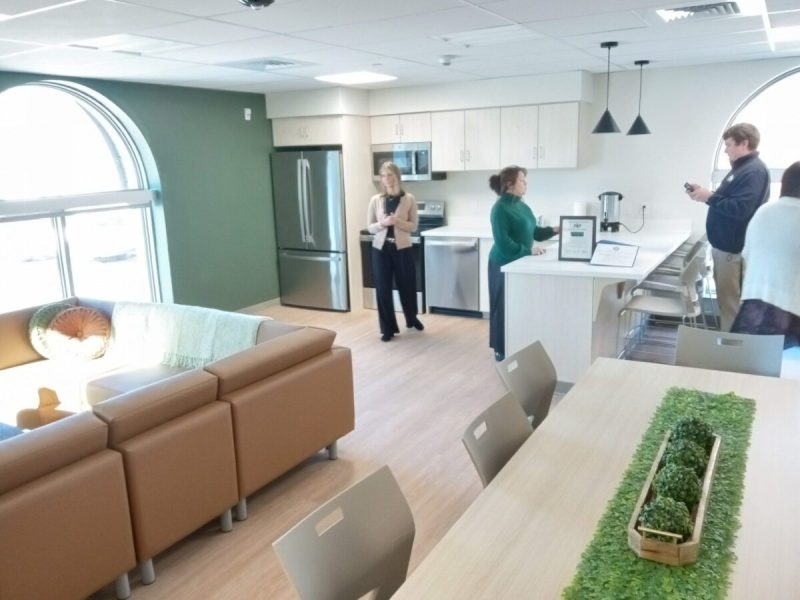
A dedication ceremony was held Dec. 12 for the new mental health urgent care facility at 100 Park St., Honesdale, the first of its kind in Wayne County. The walk-in clinic, with short-term inpatient availability, is operated by the Center for Community Resources (CCR), which has had a walk-in/call-in site on Main Street since 2021.
The walk-in crisis intervention service officially opened at this location on Dec. 18, Commissioner Joceyln Cramer said. The new crisis residential services are expected to be available hopefully by late January or early February, she said, pending the state license.
The facility, known as the Northeast Regional Crisis Stabilization Center, is in the former site of the Women’s Health Center, which relocated to 626 Park Street in 2022.
Wayne County brought CCR, a nonprofit organization, to the county under a behavioral health contract. CCR partners with the Wayne County Office of Behavioral Health.
Mental health services provided by CCR are free to the public and confidential.
CCR’s crisis intervention services, which were offered at 616 Main Street and have been relocated to the new site, include walk-in mental health intervention, assessment, support, screening, and referral services; telephone, chat, and text crisis services; and mobile crisis services.
All these services are available 24 hours a day, seven days a week, including all major holidays.
Victoria Toomey, CCR outreach coordinator, said that CCR doesn’t typically release specific statistics, but serves “thousands” of people annually in Wayne County. “We are excited for the new center and it giving us the ability to hopefully reach even more in the Northeast Region,” Toomey said.
She said that the Northeast Regional Crisis Stabilization Center is the first program of its kind for CCR.
Following the speeches in which the many legislative and funding partners were thanked, the county commissioners and CCR staff held a ribbon cutting. Tours of the newly renovated facility followed.
Commissioner James Shook, in his remarks, reflected that the brain is the most complex organ, hard to understand and hardest to diagnose. Alcohol and drug abuse can worsen mental health issues, he said. He said that having a mental health facility “in our backyard” is probably the best asset in Wayne County, long-term. It also takes the pressure off the Wayne Memorial Hospital emergency room, where people with mental health crises have been going to wait for treatment.
Commissioner Chair Brian Smith lauded the efforts over the past 10 years by boards of commissioners and many others to come together to find and realize a solution to serve people undergoing mental health crises. Cramer said that all agreed on the need for these services.
The county purchased the site for $683,000 using federally allocated American Rescue Plan money, an economic stimulus package approved by Congress in the wake of the COVID-19 pandemic. The total design, purchase and renovation cost was $3,311,912, County Clerk Andrew Seder said in an email. The Health Resources and Services Administration, part of the U.S. Department of Health and Human Services, provided $2 million. Other funding partners included the Community Development Block Grant Program, and a donation of $350,000 from the Moses Taylor Foundation, though the Wayne County Community Foundation, Seder said.
Former Congressman Matt Cartwright, who helped support the federal funding request, said that mental health issues are not a moral problem, but illnesses. He called this new facility “a real step forward” to educate the public on this point.
Patty Gilgore, CCR director of programs at Pottsville, said that since CCR arrived in Honesdale four years ago it has been working at reducing the stigma that discourages people from asking for help. Providing this facility, which she called a “safe place,” is inspiring and allows for more resources to better people’s lives.
On the tour, Radzieski showed the crisis call-in center room where trained counselors in separate booths monitor the phones and computers screens for anyone calling, texting or sending an online chat message asking for help or someone to listen to them.
A trained crisis specialist greets anyone stopping in for help. The specialist will assess the situation and determine if the person is in any immediate danger. If needed, a hospital or other facility will be found close to where the person lives. The specialist will actively listen and create a plan for future needs, CCR states. The client will be connected with appropriate community resources and be offered voluntary contacts to see if other resources are needed.
Observation rooms are available for walk-in clients who are waiting to be transferred to another facility for further help.
Radzieski showed the five bedrooms available and kitchen facilities for clients needing temporary respite. There are eight beds in all. Some rooms have two beds. Clients needing this service can stay up to five days, or longer if approved, she said. The rooms, she said, will be made to feel “homey” for the comfort of their client guests.
Mobile crisis services are provided if a crisis specialist needs to meet the person reaching out for help, in that person’s home or elsewhere.
CCR is a statewide human services agency based in Butler, Pennsylvania. CCR has 17 physical sites across the state and provides services in 37 counties.
Anyone seeking help (24 hours a day, seven days a week) from the Northeast Regional Crisis Stabilization Center can call the Wayne County Crisis Hotline at 1-833-557-3224 or 998, send a text to 63288 or send a chat message at ccrinfo.org.