Pennie, the state’s health care marketplace, could lose close to half of its customers if Republicans allow federal tax credits to expire at the end of this year.
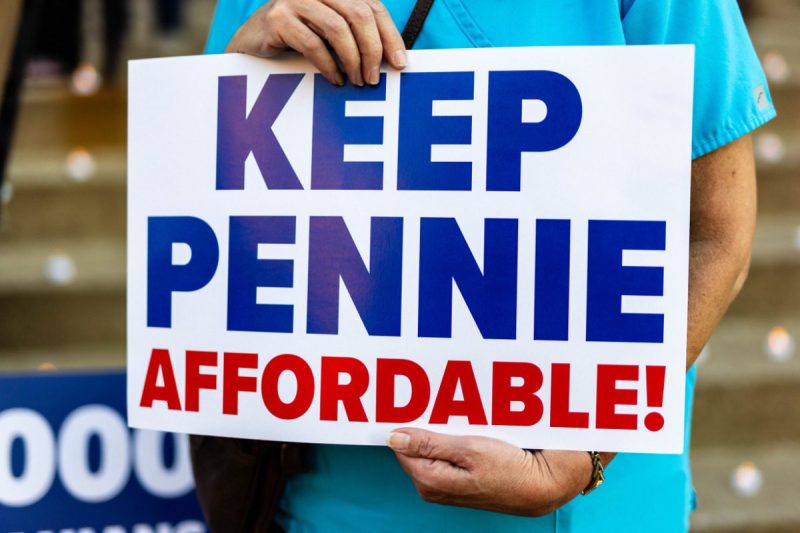
US Rep. Rob Bresnahan (R-Luzerne) may have canceled his fundraiser with House Speaker Mike Johnson in Scranton on Sunday, but that didn’t stop dozens of community members and health care workers from holding a candle light vigil for the 250,000 Pennsylvanians who may lose their health care if Affordable Care Act (ACA) tax credits expire at the end of this year.
Nearly 500,000 Pennsylvanians purchase their health care through Pennie, the state’s health care marketplace, with roughly 85% of them receiving Enhanced Premium Tax Credits to help make their premiums more affordable. Unless the Trump administration and Congress extend the credits, an overwhelming majority of those who get coverage via Pennie are expected to see their premiums increase next year.
Heidi Sheldon, a psychotherapist living in Lackawanna County, is one of the families facing steep premium increases. According to Pennie, the average family living in Bresnahan’s district is expected to see their premiums increase by 71% if the tax credits expire.
Related: 20 billionaires and counting: US Rep. Rob Bresnahan’s ultra-wealthy donors revealed
“ It’s already very expensive. I cover myself and my young adult son. My daughter also works a job with no benefits and she relies on the Affordable Care Act and uses Pennie for her benefits,” Sheldon said. “We may be at risk of not having healthcare next year, and it’s very scary to consider that.”
She added: “For my son and I, it is presently $252 [per month], and if that doubles, it would just be really tight. We have a huge deductible of $7,500, copays for every visit are like $65. It just adds up very quickly.”
Prior to the shutdown, Bresnahan cosigned a bill that would extend the ACA tax credits by one year, but Jessica Brittain, the Organizing Director with Action Together NEPA, described that as disingenuous.
“[Bresnahan] is now saying that a one year extension on those tax credits for the ACA is good enough as though someone who can’t afford their insurance to double right now would be able to afford it in a year,” Brittain said in an interview. “It’s just disingenuous, especially from a man who’s flying around in his own private helicopter.”
As families lose coverage, the ripple effects on the broader healthcare system will also be massive.
”The slashing of Medicaid and Pennie will also cause service cuts, layoffs, closures, throughout home care programs, clinics, nursing homes, and vulnerable hospitals like mine,” Susan Wiggins, a medical laboratory technologist at the Regional Hospital of Scranton, said at the vigil.
“At Regional, we’re already barely hanging on by a thread. These cuts will lead to more financial losses, making it even harder for us to provide care for our over 381,000 patient visits every year.”
The Pennsylvania Office of Rural Health estimates that five rural hospitals across the commonwealth, which includes Regional Hospital of Scranton, are at risk of closing because of President Donald Trump’s “One Big Beautiful Bill” Act, which cut Medicaid by roughly $1 trillion.
Since taking office earlier this year, Bresnahan has made a name for himself by becoming one of the most prolific stock traders in Congress.
The New York Times reported that Bresnahan sold between $100,001 and $250,000 in bonds issued by the Allegheny County Hospital Development Authority for the University of Pittsburgh Medical Center. Bresnahan’s trade came after a report warned about rural hospital closures.
Malane Gallagher, a Luzerne County resident, had a pretty simple message for Bresnahan.
“He’s a sellout. I think he sold out his community,” Gallagher said. “He actually lives not far from where I live—he’s one town over from where I live—and I just think he sold us all out.”