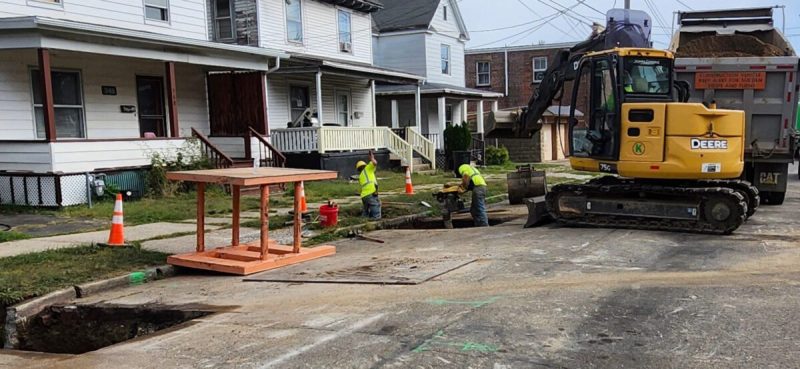
If noise, heavy equipment and slicing holes into the street helps protect public health, Rebekah Weaver is more than willing to endure some inconvenience.
Weaver, 29, lives in the 1000 block of West 28th Street in southwest Erie, one of the areas that was a recent focus of the Erie Water Works’ ongoing $72 million, multi-year plan to update aging infrastructure and ensure water quality.
“If we need the improvements, then I’m all for it,” said Weaver, who has lived in the neighborhood for about a year.
The project aims to remove nearly 7,400 potentially-hazardous lead service lines and connections from the city’s system, and more than 5,500 such connections in various parts of the city have been removed and replaced with new lead-free pipe, according to Erie Water Works officials.
That means roughly 75% of the work has been completed.
The project will help to keep residents’ drinking water safe and lead-free by removing deteriorating galvanized pipe — some sections or connections are more than 100 years old — that likely contain lead deposits and pose a health hazard, according to Erie Water Works officials.
Weaver said the water pressure at her home fluctuated for “about a day,” but the work has not been a major disruption.
“I know that lead is not the best for our health, so it’s nice to see these kinds of improvements happening in the city,” Weaver said. “I noticed the pressure was down at my house one time, in the morning, while they were working. But I can’t really complain.”
The work is one of the largest ongoing capital improvement projects in years for Erie Water Works, which operates the water system on the city’s behalf via a long-term lease agreement. The work is focused primarily on the city of Erie because most other areas of the regional water system don’t contain lead pipes and connections.
Work progressing ‘all over the city’
Erie Water Works began removing some lead connections and pipes from the system as far back as 2004, said the utility’s CEO, Craig Palmer, who added that he hopes to have about 85% of the project finished by 2025.
The entire project should be finished by 2027, Palmer said.
“The crews have been working all over the city this summer, and we’ll probably have them work until the beginning of December before a weather break,” Palmer said. “In terms of cutting, excavating and digging we shut down for December, January and February. The contractors will start up again in March.”
The lead pipe connections being replaced, commonly referred to as “goosenecks,” are small sections of pipe, one to two feet long, that connect customers’ water service lines to EWW’s older cast-iron water mains.
Erie Water Works is also replacing many private water service lines that were made of either wrought iron or galvanized pipe, at no cost to the property owner.
Contractors often must be allowed into private properties by the owner to determine the specific configuration of the water lines there and what kinds of materials are involved.
Erie Water Works used Geographic Information System technology, which is computer-based mapping software, to identify underground connections; the age of each connection; and their structural integrity, among other details.
Financing breakdown
The project’s funding consists of $56.8 million in state and federal grants and $16 million in loans, Palmer said; the borrowing includes 30-year terms at a 1% interest rate.
Funding includes, but is not limited to:
- $24 million from the Infrastructure Investment and Jobs Act;
- A $9.6 million grant from the Pennsylvania Infrastructure Investment Authority;
- A $400,000 low-interest state loan;
- $6.5 million from the Water Infrastructure Fund Transfer Act.
The lead pipe replacement initiative also allows Erie Water Works to comply with new federal regulations. The U.S. Environmental Protection Agency in 2023 announced a proposal that requires most U.S. cities to replace lead water pipes within 10 years.
It also eliminates the loss of water due to leaking, aged pipes, and reduces Erie Water Works’ associated expenses related to those leaks, such as emergency repairs, Palmer said.
Erie Water Works has more than 63,000 residential, commercial, industrial and institutional customers in Erie, Lawrence Park Township, Wesleyville and Millcreek Township, as well as parts of Harborcreek, McKean, Greene and Summit townships.
Many of the areas targeted for water line replacement in the city are located in state-designated Environmental Justice areas, defined by the Pennsylvania Department of Environmental Protection as any census tract where 20% or more of the residents live at or below the federal poverty line or where 30% of the population identifies as a non-white minority.